How do some local climate initiatives achieve remarkable impact? We think we have some of the answers.
When Carbon Copy commissioned Eunomia to conduct research across the UK, our aim was simple. We wanted to identify the key factors behind successful projects and share practical advice for councils, communities and organisations to copy what’s working.
Backed up by our national collection of over 600 stories, it was very apparent that project ‘success’ is about more than reducing carbon emissions and that working together is essential for achieving remarkable impacts.
The result was to define success in terms of a Changeprint and turn the insights into a high-impact action guide.
In March 2026 we published From Footprint to Changeprint: High Impact Local Climate Action Guide. The report identifies twelve success factors, which fall into three core characteristics: a mindset of Abundance, a sense of Belonging and a Purposeful approach.
Less than six months since the report became available, it has already been accessed by over 550 individuals, representing around 500 different groups and organisations across the country. We’ve heard from many that the report resonates strongly with their work, and that they are using it as a way to establish where they can improve and grow their impact.
Sue Jefferson, cofounder of Circular Malton & Norton said:
Can I say what an EXCELLENT guide you have created… I was nodding, making notes, having aha moments as it articulated where our gaps are… this is now to become our organisation’s go-to guide.”
From Footprint to Changeprint has been shared with over 1000 local People’s Emergency Briefing organisers, and several hundred Great Big Green Week event hosts. Our goal was to support those whose interests and ambitions around local climate action had been sparked by participating in these high-profile national events.
The response has been fantastic, with dozens more people accessing the report and sharing their thoughts with us. The guide is proving very useful for:
- Finding inspiration: “We have used some of the case studies – particularly from circular economy projects – as inspiration for how to kick off similar projects in our area”.
- Involving more people: “It reinforces the view that we engage with the majority by being concrete and practical. Addressing the everyday effects of climate in order to find non-partisan entry points”.
- Aligning different groups, “Good to hear what techniques are useful in engaging with a diverse community… The document will be a useful reference and planning tool”.
- And copying successful projects, “As a recently formed local Climate Action group (as a follow-on from the People’s Emergency Briefing film) seeing projects up and running with a blueprint to work from is perfect”.
If you think your project, group or organisation could benefit from this practical guide to working together effectively, and you’ve not yet had the chance to check it out, it’s still available to download free from our website.
If you’re looking for what to do next, we’re now giving you the opportunity to put this learning into practice – taking the findings of the research and applying them to real-world situations through a series of free online Community-to-Community Workshops.
Whether you’ve recently started or joined a local group, or whether you are an established organisation looking to take its work to the next level – these workshops are a valuable opportunity to make connections, learn from each other and from the real-life example of a high-impact project.
How joining up individual nature projects has much bigger benefits for communities and nature.
Local nature-based solutions at a landscape level are one of the most powerful ways to tackle the twin crises of climate change and nature loss whilst providing multiple benefits for people as well as wildlife. From restoring woodlands and wetlands to bringing back beavers and rebuilding marine habitats, the idea is to take a more interconnected approach in working with and alongside nature.
Even at scale, we can become focused on an individual intervention: planting trees here, restoring a riverbank there, reintroducing a species somewhere else. These projects can be valuable in their own right, but nature does not work in our neat project boundaries.
Rivers connect hillsides to estuaries. Woodlands influence water flowing into the sea. Wetlands affect flood risk downstream. Farmers, communities, businesses and wildlife all depend on the same landscapes, even if they experience them in very different ways.
If nature-based solutions are going to help us respond to climate change and biodiversity loss at the scale required, we need to think bigger locally. We need to think in landscapes and where land meets water, in catchments and seascapes too.
From individual projects to connected systems
A landscape perspective begins with a simple shift in mindset. Instead of asking, “What nature-based solution could work in this specific area?” we ask, “What is happening across the whole system and how can nature help us achieve multiple outcomes at once?”
This connected approach matters because the environmental challenges we face are rarely confined to one place. Take flooding. A flood risk problem in a town may have its origins much further upstream, where land management influences how quickly rainwater reaches a river. Improving soils, restoring wetlands, reconnecting floodplains or changing woodland management could all influence what happens downstream.
Or take declining coastal ecosystems. Looking only at the sea might lead us to focus on marine restoration. But what happens on the land can determine what reaches the coast through rivers: nutrients, sediment, pollutants and freshwater. The health of the sea depends partly on decisions being made many miles inland.
And then there are people. Landscapes are not simply collections of habitats. They are places where people farm, work, travel, live, recreate and build communities. Any wider conservation approach that ignores these relationships is unlikely to succeed over the long term.
Taking a wholescape approach
Rather than treating nature recovery as a series of isolated sites, WWF-UK is working across whole areas in Norfolk, Pembrokeshire and the Firth of Forth. Its innovative Wholescape Programme is looking beyond individual habitats to bringing together land, rivers, coasts, seas and the communities that depend on them.
In Norfolk, for example, the challenge is particularly interconnected. The county is an important food-producing landscape, contains freshwater and coastal ecosystems, and is vulnerable to climate impacts because of its low-lying geography.
WWF-UK, working with delivery partners Norfolk Rivers Trust is exploring how working at landscape and seascape levels helps identify solutions that benefit nature, climate and people simultaneously. A wetland is not just a wetland. It can be wildlife habitat, flood infrastructure, carbon storage, water-quality improvement and a place for people to connect with nature. A river is not just a channel for carrying water or dumping waste. It’s part of a system connecting farms, communities, freshwater habitats, estuaries and the sea. A farm is not simply a site for food production. How it’s managed influences local biodiversity, water quality, carbon capture, flood risk and the resilience of the wider landscape.
Shaping seascapes on dry land
The No Trees No Seas campaign by Plant One in Cornwall takes this connected-systems idea and makes it particularly tangible. Its central message is deliberately provocative: the key to healing our seas lies on the land.
At first glance, restoring woodland and restoring marine ecosystems might appear to be completely separate activities. One belongs in the hills and valleys; the other belongs beneath the waves.
But follow the water. Rain falls on woodland and soils, enters streams and rivers, travels through catchments and eventually reaches estuaries and the sea. What happens along that journey affects the health of downstream ecosystems.
The campaign describes these connections through the idea of a ‘flowscape’: a living system in which life and energy flow from forest floors into headwaters, rivers and estuaries, out towards the ocean and back again. It argues that Britain contains hundreds of these connected flowscapes, each linking a headwater catchment to the sea.
This is the kind of perspective that can transform how we think about nature-based solutions. Planting or restoring woodland is no longer simply about putting trees on land. In the right location, restoring native, species-rich woodland can help influence water flows, reduce erosion and sediment movement, support biodiversity and improve the conditions that ultimately affect downstream freshwater and marine habitats.
The No Trees No Seas campaign highlights the connections between forests, rivers, fish, seabirds and marine ecosystems, and is using this thinking to guide woodland restoration in Cornwall.
Once we see the connections, the question changes from “Where should we plant trees?” to “Where could woodland restoration create the greatest benefits across the whole system?” That’s a more interesting question with a much bigger potential impact.
Collaborating with nature
The same landscape thinking can apply in our towns and cities too, as the Ealing Beaver Project demonstrates in urban Greenford, London. In October 2023, a family of Eurasian beavers was introduced in a 10-hectare site within the local Horsenden Hill landscape.
Beavers are not simply another species to add to a list. They are ecosystem engineers. Through their feeding and dam-building activities, they alter water movement and create a mosaic of ponds, wetlands, deadwood, shrubs and woodland.
The Ealing project has three explicit objectives: mitigating flooding, boosting biodiversity and engaging local people with nature and nature-based solutions. This combination is significant. A conventional conservation project might have focused primarily on the ecological benefits of bringing beavers back. But the Ealing project is asking a broader question: how can a keystone species help an urban community become more resilient whilst also restoring biodiversity?
That is a landscape question. The site itself occupies a low-lying basin, making water management particularly relevant. The project is investigating how beavers can help mitigate flooding and drought while monitoring their effects within an urban catchment.
There’s another benefit that is sometimes overlooked: imagination. Seeing beavers living in London challenges the idea that nature recovery belongs somewhere remote and rural. It demonstrates that nature-based landscape solutions can happen in places where millions of people live.
Bringing landscape thinking into your community
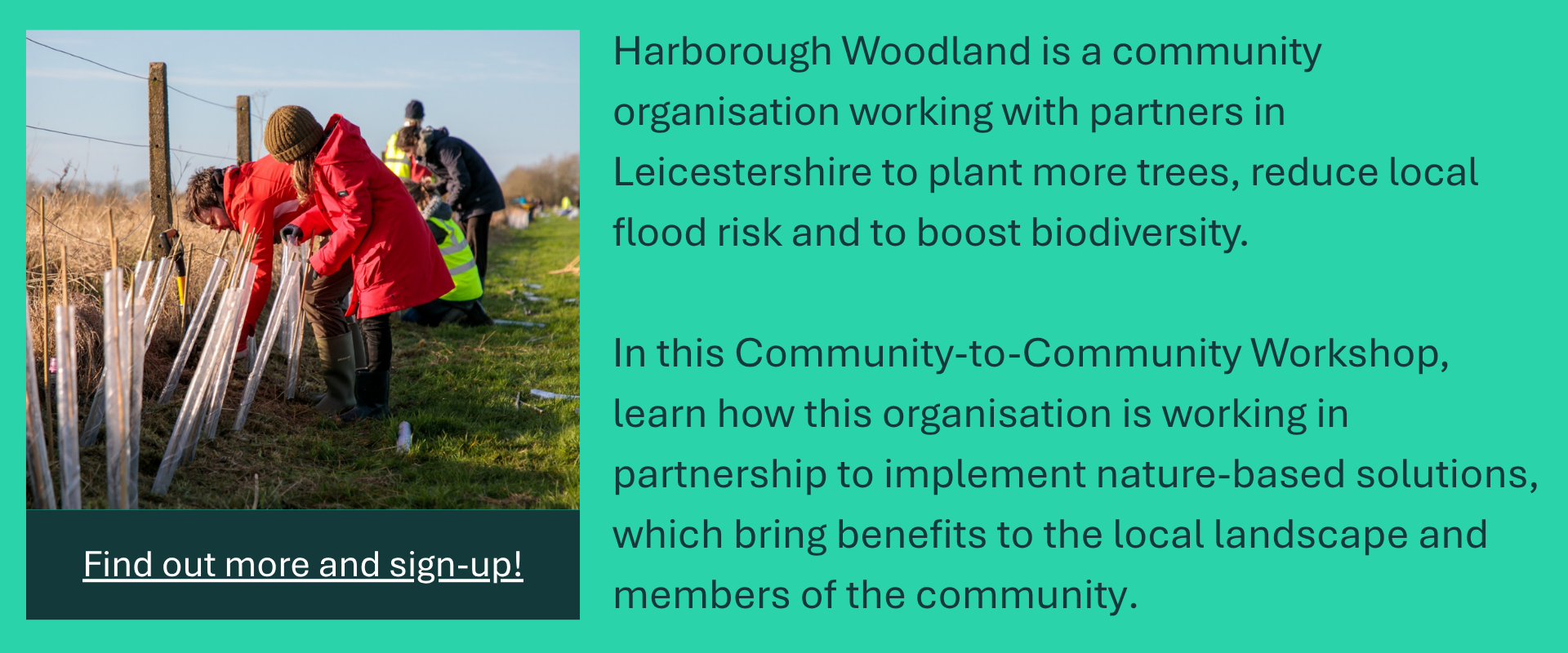
Carbon Copy is keen to help you bring this kind of connected approach to implementing nature projects in our own area. We are hosting a Community-to-Community Workshop where you can learn directly from those who have successfully implemented landscape thinking to connecting nature-based solutions. Harborough Woodland is a community organisation working with partners in Leicestershire to plant more trees, reduce local flood risk and to boost biodiversity in ways that work for communities and wildlife.
If you are involved in individual nature-based solutions and interested in a more joined-up local landscape approach, then this free online session on October 20 might be for you!
We’re launching an innovative pilot series of Commmunity-to-Community Workshops to catalyse local climate action.
With generous support from the National Lottery Community Fund, we are working with four highly successful local initiatives from across England to accelerate peer-to-peer learning and the spread of place-based innovation across the UK.
In addition to the useful resources and inspiring content about collective local climate and nature projects that we share, a recent stakeholder survey highlighted the demand for more opportunities to learn directly from those involved.
These workshops build on the recent research report and high-impact local action guide, From Footprint to Changeprint, commissioned by Carbon Copy. This guide has been used extensively this year as a local climate action resource, with over 550 downloads by hundreds of different organisations. Combined with peer-to-peer learning, these Community-to-Community Workshops are designed to strengthen the factors for success in each participants’ own work.
Our approach is based on the fundamental notion that copying is human nature, and therefore, the our work is underpinned by the idea that the fastest way to accelerate change is to share it. These innovative workshops are designed to help people adapt what’s working elsewhere to their local context so that it spreads.
Working with professional facilitator Roy Kareem (formerly of the Centre for Sustainable Energy and Bright Green Future), this mini-series of online Community-to-Community Workshops are hoped to be a pilot for an expanded series in the future. We’ll feature four very different high-impact organisations over four weeks, starting Tuesday 29 September.
All the workshop guests are trailblazers who are implementing innovative, big ideas.
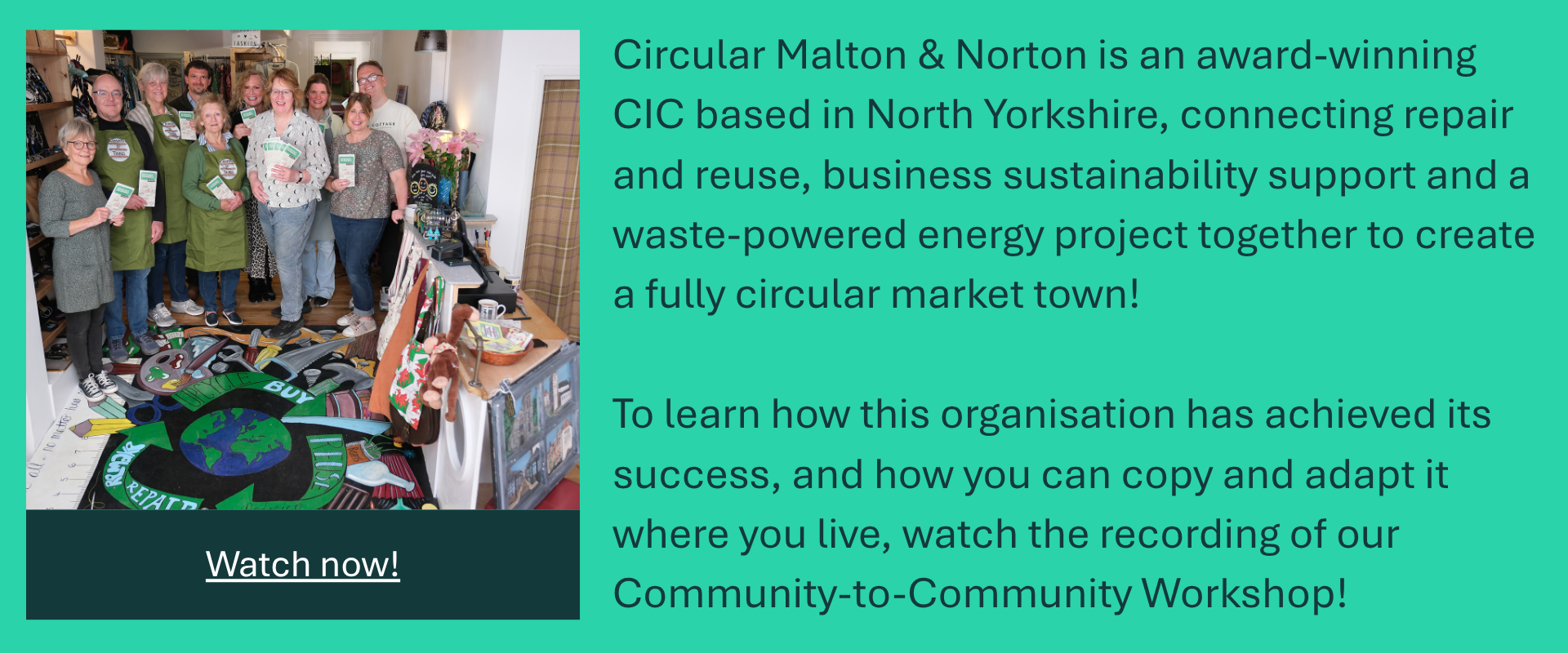
The first guest project, featured in the workshop on September 29, will be Circular Malton & Norton; the UK’s first circular economy market town. This lively session will provide insight into linking different eco-groups, projects and businesses to create a fully joined-up circular economy locally.
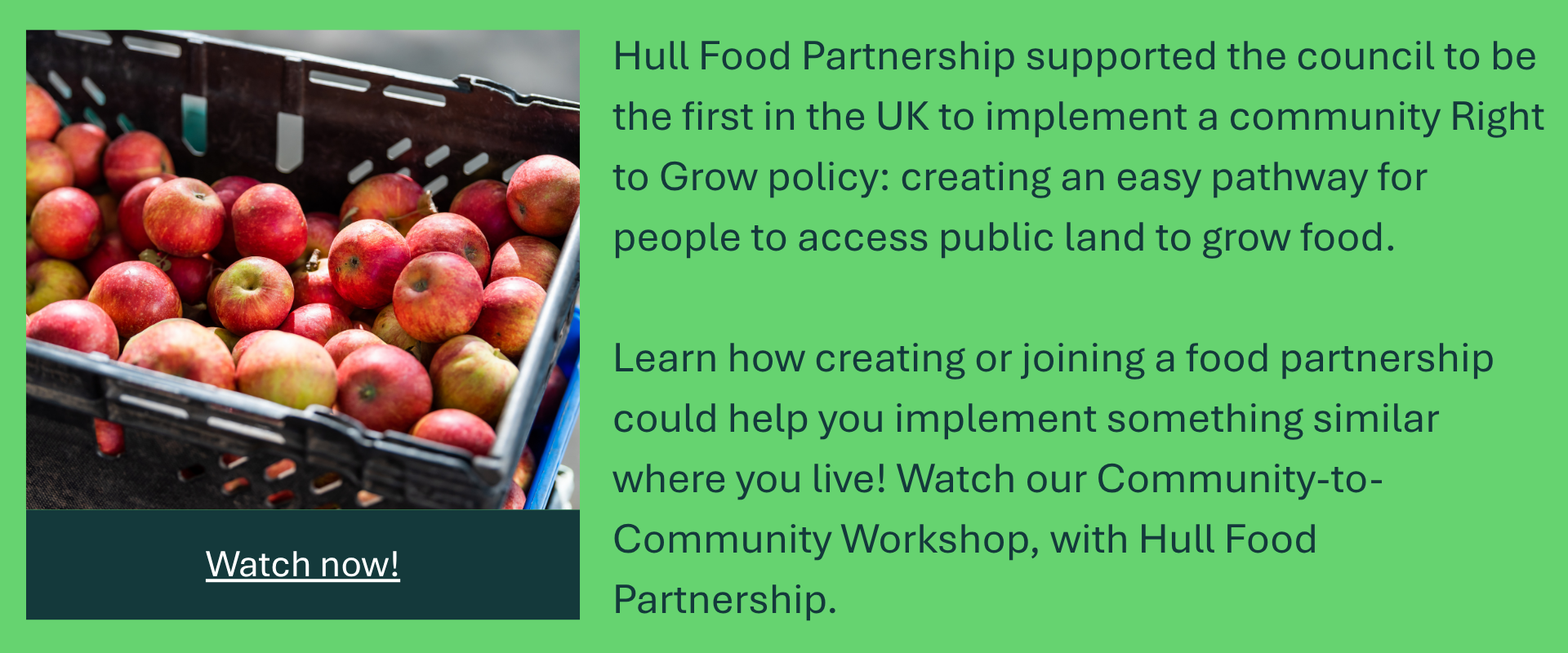
On October 5, Hull Food Partnership will join a session about sustainable food systems and their pioneering implementation of a Right To Grow policy in Hull; the first city in the UK with a community right to grow.
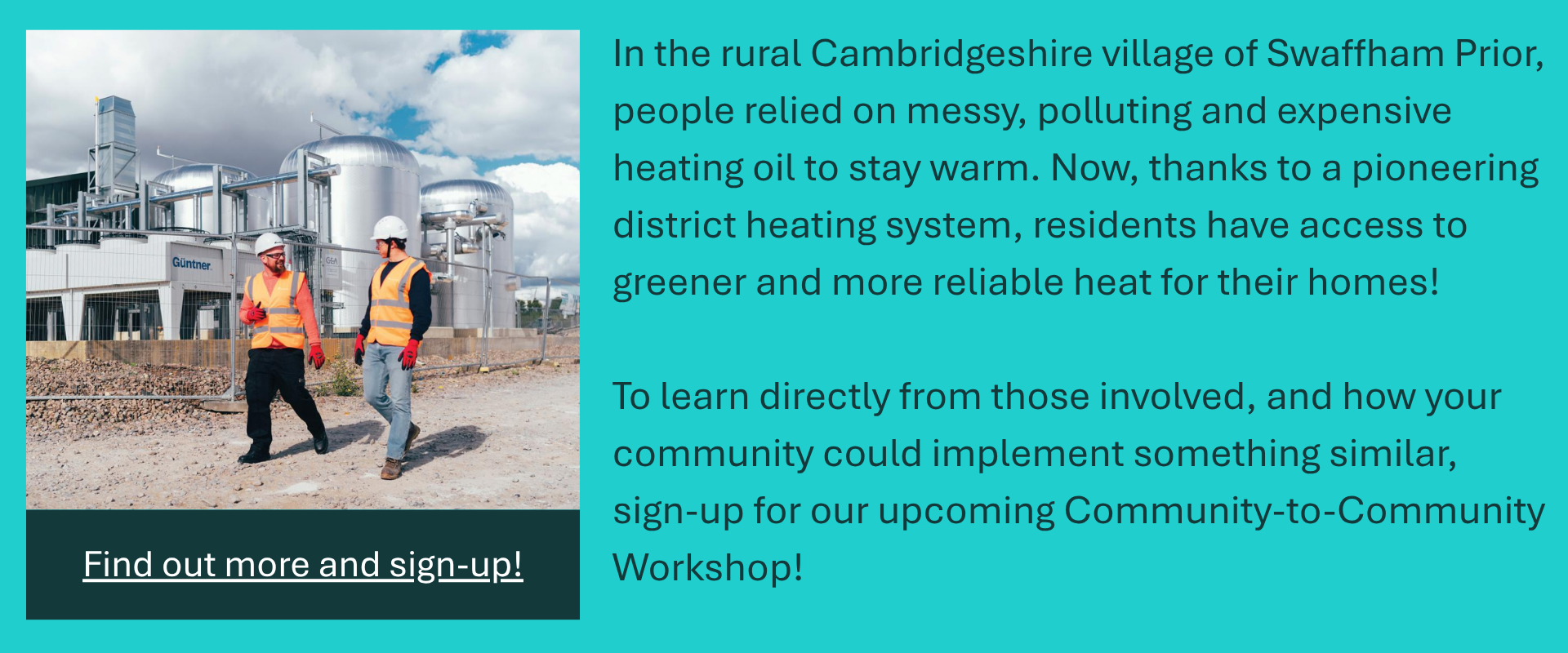
Then, on October 13, guests from Cambridgeshire County Council will deliver a session about the Swaffham Prior Heat Network – a rural community whose reliance on heating oil is being transformed through a shared ground source heat pump system; the first village in the UK reliant on oil to switch.
Finally, on October 20, participants will learn about nature-based solutions to flooding and climate change, from Leicestershire-based community project, Harborough Woodland; a pioneering programme that’s taking a whole landscape approach to join up individual nature projects.
Carbon Copy’s co-founder Ric Casale said:
“We know that hearing real-life stories about people coming together to take action for climate and nature can be hugely inspiring. But sometimes just hearing the story can leave you with more questions than answers. How can we do the same where we live and work? What are the key success factors? Can we make a similar difference in our area?
“These Community-to-Community Workshops draw on new research findings and practical insights from our High-Impact Local Action Guide, as well as groundbreaking examples from inspiring projects, to help participants feel empowered and motivated to copy successful projects. We’re hugely grateful to the National Lottery Community Fund for their support, which will enable us to reach hundreds of new local changemakers across England.”
How the Right to Grow could help your community reap the benefits of locally produced food.
Could unused council land become somewhere for communities to grow their own food? That’s the idea behind the community Right to Grow, a policy that makes it easier for local people to access suitable public land for food growing. At a time when the UK relies heavily on imported food, it could also help communities produce more food locally and build greater food resilience.
The UK imports around 40% of its food overall, but this figure jumps substantially when it comes to fruit and veg. The latest figures put vegetable imports at just under 50%, and fruit at a whopping 80%.
The reasons behind this are complex, but whatever the cause, this reliance on foreign food puts us all at a far greater risk of shortages than a more self-sufficient nation.
What is the community Right to Grow?
The majority of people in the UK live in towns and cities. Whilst some have access to a garden or outdoor space, many live in flats and apartments and have no space to grow food.
Enter Incredible Edible. The movement, founded in Todmorden, Yorkshire, has now spread all over the world, and focuses on encouraging people to grow their own fresh fruit and veg anywhere where there is free space. Over the last few years, Incredible Edible has led the campaign for places around the UK to implement a community Right to Grow.
The community Right to Grow is a policy designed to make it easier for people to access suitable council-owned land to grow food. So far adopted by Hull, Cumberland, St Albans, Southwark and several other councils, it creates a simpler mechanism through which local people can apply to use available public land for planting and growing produce.
Often, a local food partnership is involved with setting up the policy – working directly with the local council and food-related organisations to put the application process and mechanisms in place.
Read more about food partnerships on our action page here.
The benefits of a Right to Grow extend beyond producing more food locally. Making unused land available for community food growing can reduce maintenance requirements for councils, help people develop growing and horticultural skills, and create opportunities for neighbours to connect. It can also give people without their own gardens access to growing space and help more people understand where their food comes from.
How unused land can become community growing space
There are many projects that have taken advantage of disused space for food growing, without an “official” community Right to Grow.
In London, Global Generation has been creating urban gardens on disused land since 2004. Working in particular with children and families, the charity is helping to improve access to fresh food, as well as teaching cooking and food preparation skills and supporting the confidence and mental health of participants.
Manchester Urban Diggers are helping refugees and asylum seekers connect with new people and share their heritage through food, with the Stronger Roots project, hosted at an urban garden on a former bowling green.
In Cornwall, Chyan is a community farm and permaculture project, which uses a formerly overgrown and unloved field to run growing projects including Roots and Seeds, a volunteer gardening group; and a Nature Playgroup, for families with young children.
These projects show what communities can achieve with unused land, but they can require considerable time and determination to secure access and permission. A community Right to Grow creates a clearer route for doing this, usually through an application hosted by the local authority or food partnership, with a defined process from initial enquiry to implementation.
Learn how to bring the Right to Grow to your community
Carbon Copy is hosting a Community-to-Community Workshop where you can learn directly from those who have successfully implemented this kind of initiative. Hull Food Partnership was instrumental in establishing the community Right to Grow in Hull – the first place in the UK to implement this policy.
If you are involved with a food partnership, or a local group that would benefit from access to land for food growing, then you might benefit from watching our recent Community-to-Community Workshop with Hull Food Partnership, where members of the team behind the Right to Grow gave us firsthand insights into how it all happened.
What is the community Right to Grow?
The community Right to Grow is a local policy that makes it easier for people to access suitable council-owned land for growing food. Instead of community groups having to navigate an unclear process to gain permission, participating councils provide a defined route for applying to use available land for growing.
Which councils have a Right to Grow?
A growing number of UK councils have adopted a community Right to Grow policy, including Hull, Cumberland, St Albans and Southwark. Hull became the first place in the UK to implement the policy, supported by Hull Food Partnership.
What land can be used for community food growing?
Community food growing can take place on many different types of suitable unused or underused land. Examples around the UK include urban plots, former bowling greens and previously overgrown fields. Where a Right to Grow policy exists, the local authority determines which council-owned sites can be made available and how people can apply to use them.
What are the benefits of community food growing?
Community food growing can increase access to locally produced fruit and vegetables while helping people learn practical growing skills. Projects can also bring people together, provide opportunities to spend time outdoors and turn unused spaces into productive community assets.
How can I start a community growing project?
The process depends on where you live and who owns the land you want to use. If your council has a Right to Grow policy, there may already be a formal application process for accessing suitable public land. Local food partnerships and existing community growing organisations can also be useful places to start when exploring opportunities in your area.
How communities like yours could benefit from district heating systems.
District heating systems, also known as heat networks, provide heating and hot water to multiple homes and buildings from a shared source instead of each property relying on its own boiler or heating system. For rural communities that still depend on expensive, polluting heating oil, community heat networks could offer a cleaner and more reliable alternative.
Imagine houses across England kept warm through cold, wet winters by renewable energy that’s sourced locally and piped under the street to individual homes. You might think district heating is, well… a pipe dream. Or, if you’re familiar with the government’s new heat network zoning strategy, that it’s something reserved for large towns and cities. On both counts, think again.
About 800,000 households in England– many of them rural – still rely on oil for heating [Calculated using English Housing Survey 2023-4 and 2021 Census]. It’s messy, expensive, and bad for the environment, pushing out more emissions per unit of heat than even gas. And while homes on gas are protected to some extent by the energy price cap, oil prices are high and volatile, making heating oil users especially vulnerable to fuel poverty. It’s also unreliable, with householders expected to make sure their own fuel supplies remain topped up.
The government is aiming for heat networks to supply 20 per cent of England’s heat demand by 2050, a significant increase from the current 3 percent, focusing on major towns and cities. Rural communities are not included in this strategy. But thanks to the collaborative efforts of local community groups and councils, supported by energy co-operatives and charities, some rural communities up and down the country are already planning to create heat networks of their own.
Developing a community heat network can be complex, particularly when it comes to identifying suitable locations, funding and viable business models. The Community Heat Development Unit (CHDU) was an 18-month research and innovation project specifically set up to help communities explore these challenges.
It was specifically set up to help communities develop their own heat networks, using data to identify good locations and viable business models. It’s led by the Sharenergy cooperative, with partners Community Energy England, Marches Energy Advice (retrofit/insulation experts) and Carbon Alternatives (technical heat network design), with funding from the Energy Industry Voluntary Redress Scheme.
Swaffham Prior in East Cambridgeshire shows what a rural community heat network can look like in practice. Swaffham Prior Community Land Trust and Cambridgeshire County Council (CCC) have worked together to offer a green heating alternative to oil. Using ground source heat pumps with backup from electric boilers and a nearby solar farm, sustainable thermal energy is now being pumped under the streets into homes, with a commitment to connect nearly all the homes in the village to the scheme.
How are rural communities developing heat networks?
Swaffham Prior, the UK’s first rural heat network, is the pathfinder for a handful of other rural English communities in Northumberland, Staffordshire and Hertfordshire, which are now actively trying to clear the same feasibility and funding hurdles. The goal is affordable, dependable clean energy, and an end to fuel poverty.
No one is pretending it’s easy or straightforward. Bishop’s Castle in Shropshire has been pursuing a community wind turbine and heat pump heating network, run by Shropshire & Telford Community Energy, Sharenergy, and Lightfoot Enterprises. After winning planning permission for the 900kW community wind turbine in 2025, building that into a full heat network has proved much harder. The heat network side is currently stalled on funding and pipe costs.
Haydon Bridge in Northumberland is another pioneer village keen to promote the deployment of rural district heating owned by communities. The project, led by heat network consultancy Reheat, working with the rural community-support charity Community Action Northumberland and the Rural Design Centre, is at feasibility stage.
Bioregional, who led development of the BedZED eco-village and the One Planet Living sustainability framework, has worked with four local communities across England to explore the feasibility of developing community-led, net-zero-carbon compatible heating networks: Whittington and Fisherwick in Staffordshire; Shenstone in Staffordshire; Brightwell-cum-Sotwell in Oxfordshire, and Grand Union Community at Kings Langley in Hertfordshire.
What does a community heat network need to succeed?
Creating a successful community heat network involves much more than choosing a renewable heat source. Projects need to understand local energy demand, identify suitable sources of heat, develop a financially viable model and, crucially, secure support from the people who will use it.
Work with communities across England has included modelling the energy demand of existing buildings, exploring different local heat sources and developing technically and economically feasible solutions for community-wide heat networks.
Community engagement is equally important. Residents need to understand what a new heating system could mean for them, including potential benefits such as long-term price stability, lower-carbon energy, opportunities for local ownership and potential investment.
In many cases, local Climate Action Networks can provide the civic infrastructure that makes community energy projects possible: trusted local networks that can knock on doors, hold public meetings and build the kind of community buy-in that helped Swaffham Prior get its scheme over the line
Learn from Swaffham Prior
Carbon Copy is hosting a Community-to-Community Workshop where you can learn directly how the team at Swaffham Prior have successfully implemented their own renewable energy heat network. If you’re keen to explore how your community could do the same, then you should sign up for this free online session on October 13!
What is district heating?
District heating is a system that supplies heat to multiple homes or buildings from a shared source. Rather than every property generating all its own heat through an individual boiler, heat is produced centrally and distributed through a network of insulated pipes. These systems are also commonly known as heat networks.
How does a district heating system work?
A district heating system generates heat from a central or shared source and distributes it to connected buildings through underground pipes. The source of heat varies between networks and can include technologies such as heat pumps and other low-carbon or renewable energy sources. Individual properties then use the heat supplied by the network for heating and hot water.
Can district heating work in rural communities?
District heating can work in rural communities where the location, number of properties, heat demand and available energy sources make a network viable. Swaffham Prior in Cambridgeshire demonstrates how a rural community can move away from individual oil heating towards a shared heat network. Other rural communities across England are now exploring whether similar approaches could work locally.
What are the benefits of community heat networks?
Community heat networks can provide a lower-carbon alternative to individual fossil fuel heating systems, depending on the source of energy used. Community-led models can also create opportunities for local ownership and greater involvement in how energy is generated and supplied. For communities dependent on heating oil, potential benefits can include more reliable heating and greater long-term price stability.
How can a community start a heat network?
Developing a community heat network usually begins by understanding local heat demand and exploring which sources of heat could work in the area. Communities also need to consider technical feasibility, costs, funding and the business model for operating the network. Building support among residents is particularly important because a community heat network needs enough properties to participate for the model to work effectively.
How you can take a local economy full circle.
A local circular economy keeps products, materials and resources in use for longer through repair, reuse, sharing, resale and recycling. Instead of valuable resources becoming waste, communities can create local systems that keep them circulating, supporting local businesses and jobs while reducing waste and environmental impact.
From repair cafés and tool libraries to refill shops, community composting and second-hand marketplaces, many of the building blocks of a circular economy already exist in communities across the UK. The opportunity is to connect them and create a stronger local system.
What is a circular economy?
In a circular economy, products and materials are kept in use for as long as possible through processes such as repair, reuse, remanufacture, recycling and composting. This reduces the need to continually extract new resources and prevents useful materials from becoming waste.
This is very different from the dominant ‘take-make-waste’ economy of today, where raw materials and natural resources are extracted, used once and then discarded as waste.
Most of us think that a circular economy is about eliminating waste and pollution, and we would be right. But there’s another, equally important element. By shifting from a take-make-waste linear economy to one that is circular, we also support natural processes and regenerate nature.
For example, food production based on circular economy principles involves moving away from soil extraction and towards soil regeneration. Regenerative food production practices reduce the need for polluting fertilizers, fossil fuels and pesticides to boost crop yields, relying instead on healthy soils to grow more food.
Circular economies can work particularly well at a local level because many of the activities that keep resources in use, including sharing, repairing, reusing and recycling, benefit from being close to the people and businesses using them. In contrast, take-make-waste economies often use cheap global shipping to extract raw materials in one country, manufacture products in another and dump waste in a third.
What are the benefits of a local circular economy?
Underpinned by the transition to renewable energy and its positive impact on nature, a local circular economy is a resilient system that is good for people, place and the surrounding environment. Benefits include:
Stronger Local Jobs: Sorting, upcycling and remanufacturing create steady jobs that cannot be easily outsourced overseas or replaced by AI.
Affordability: Extending product lifespans, easier access to repair, using goods instead of buying them, all act as money savers.
Less Waste: Reducing waste is an issue people feel very strongly about. Public polling shows how much people in the UK hate waste and how ready they are for greater ambition on using resources more efficiently.
Community Building: Tool libraries, clothing swaps, and local food composting systems rely entirely on nearby neighbourhoods and people working together.
Community Wealth: The money spent and benefits circulate locally within the community and with local businesses, rather than leaking out to multinational corporations.
Supply Security: Reduced reliance on global imports, long supply chains and exposed international shipping routes lowers the supply risks and price volatility.
Reduced Emissions: Extending product usage cuts carbon emissions from raw manufacturing, and keeping reuse and recycling networks local cuts polluting transport emissions.
Nature Replenishment: Reducing waste, pollution and emissions all help in restoring local water, soil and air quality as well as the environment more generally for both people and wildlife.
What does a local circular economy look like?
A local circular economy isn’t one individual project or business. It’s a network of organisations and services that help people keep products and resources in use for longer. Repair cafés, tool libraries, second-hand retailers, refill shops and composting projects can all form part of the same local circular economy. They can be grouped based on what they do and together they grow into a comprehensive and thriving circular economy:
Maintenance, repair and refurbishment: These organisations focus on extending the useful life of products, keeping items functioning so people don’t have to purchase brand-new replacements. Repair Café Wales, for example, supports a network of 150 individual repair cafes across Wales. Electronics refurbishers such as Fixing Factories repair small household appliances and electronics, helping to tackle e-waste. Community tool libraries like Edinburgh Tool Library act as local hubs where people not only share tools but also have tools repaired. Craft-based businesses – cobblers, tailors and furniture upholsterers – extend the lifespans of favourite footwear, clothing and expensive furniture.
Sharing and providing ‘products as a service’: Instead of buying a new bike or car or piece of equipment, people share or pay to use these products for the service they provide and for a limited time only. This maximises the use of these products while incentivising the owners to maintain them to increase their lifecycle. Library of Things have hubs across London, enabling locals to borrow a variety of things related to DIY, cleaning, gardening and more. Devizes Swap Shop and other sharing hubs are places to swap items within the local community, from toys to sports equipment. Local transit operations such as TrydaNi Car Clubs allow multiple users to share a single fleet of vehicles, providing people in rural areas with access to a car without the cost of owning one. Zero-waste and refill shops require customers to bring containers with them, sharing their containers with the retailer to eliminate single-use packaging in the outlet.
Reuse, resale and redistribution: These operations help maintain and grow the second-hand market, transferring ownership of unwanted but perfectly functional goods to new users. Charity shops and vintage retailers on the high street are very popular examples, with Charity Super.Mkt growing into a multi-brand department store for all things charity fashion. Upcycling workshops run by artisans and small manufacturers transform unwanted products into higher-value items (e.g. New 2 You turns old furniture items into interesting new pieces). Renew Hub is an example of a local marketplace that supports resale of used goods, helping people to reuse donated and discarded items on a huge scale across Greater Manchester. More generally, local scrap yards, second-hand building centres and salvage shops recover raw materials and reclaim functional parts, for reselling and redistribution.
Organic recycling and regeneration: These operations safely return biological materials back to nature, helping to restore local ecosystems. Facilities with commercial composting facilities or anaerobic digesters collect local restaurant and household food scraps, converting them into biogas for energy and nutrient-rich fertiliser for local agriculture. For example, the Humberston Eco Conservation Centre uses a novel micro anaerobic digester to create bio-energy from local garden and food waste.
How can you build a local circular economy?
Building a local circular economy doesn’t necessarily mean starting everything from scratch. Your community may already have repair cafés, reuse projects, sharing schemes, second-hand businesses or recycling initiatives that form some of the building blocks. The next step is to understand what’s already happening locally, identify the gaps and find opportunities for organisations to work together.
Every local circular economy will look different because it needs to reflect the resources, businesses and needs of the community. However, there are common approaches and lessons that communities can learn from one another.
On 29 September 2026, we hosted an online workshop with Circular Malton & Norton. In Closing The Loop, we explored how these elements come together in practice and effective ways of collaborating across an entire system.
To watch the recording of this Community-to-Community Workshop about expanding your local circular economy, click here.
What is the difference between a linear and circular economy?
A linear economy follows a take, make and waste model, where resources are extracted, turned into products and eventually discarded. A circular economy aims to keep products and materials in use for longer through repair, reuse, sharing, refurbishment, remanufacturing and recycling. This reduces waste and the demand for new raw materials.
What are some examples of a circular economy?
Circular economy examples include repair cafés, tool libraries, refill shops, community composting schemes, second-hand marketplaces and businesses that refurbish products. Car clubs and other sharing schemes can also contribute by allowing more people to use the same products rather than everyone owning their own.
How does repairing and reusing products help the environment?
Repairing and reusing products extends their useful life, reducing the need to manufacture replacements and preventing usable materials from becoming waste. This can reduce demand for raw materials and the energy and resources involved in manufacturing new products.
Can a circular economy support local businesses?
A local circular economy can create opportunities for businesses involved in repair, refurbishment, resale, sharing and resource recovery. Keeping products and materials circulating locally can also help more economic activity remain within the community.
Art has always helped us make sense of the world around us, and climate change is increasingly becoming part of that story. From theatres and festivals adapting to extreme weather to artists using their work to explore the climate crisis, the relationship between art and climate change is growing in both practical and creative ways.
We spoke to Arts Council England and looked at projects across the UK to explore how the arts are responding to climate change, supporting community resilience and helping more people engage with climate action.
How is climate change affecting the arts?
For many of us, summer is synonymous with festivals. Music, poetry, comedy, theatre – there’s an event on the calendar for almost every taste. But how do these events, and the artists and production companies behind them, cope when faced with extreme weather? We spoke to Robin Lyons, Senior Officer for Environmental Responsibility at Arts Council England, to learn more.
“Operationally, climate change is having very real impacts. We only need look at the recent heatwaves May through July to see examples of this. We’ve seen closures and changes to opening hours, challenges around performer welfare (including a need for performer hydration breaks), the disruption of transport infrastructure which is critical for our sector and of course affects our audiences, visitors, and creatives and particularly our touring productions, and we see financial impacts ranging from ticket cancellations and reduced visitor numbers through to increased building management and cooling costs…
“But at the same time as there may be negative impacts the sector is facing, we should also recognise that cultural organisations are increasingly showing themselves to be forms of public infrastructure, and a part of community resilience. A really positive example is the Cool Off in Culture campaign, where cultural venues across the country are opening their doors as free-to-use cool spaces for the public, during periods of extreme heat.”
Climate storytelling and the arts
Climate change is affecting the arts in two important ways: it is changing the conditions in which artists and cultural organisations operate, while also increasingly becoming a subject for creative work itself. The arts have long been intertwined with social change, politics and protest, and the climate movement is no different. Robin also had some thoughts on this:
“There are far too many brilliant examples of climate storytelling for me to mention any individually, so instead I’d like to highlight the Climate Playwriting Prize, which is a partnership between Shakespeare’s Globe, Climate Spring and Fern Culture. Its aim is to uncover exciting new plays about the climate crisis, and to support them to find their audiences. Submissions are open this year until the 1st of September.
“I mention the climate playwriting prize because it demonstrates in a high-profile way, how the sector itself is actively now investing in climate storytelling in a way that perhaps wasn’t commonplace ten or fifteen years ago. And this isn’t by accident; this is because the sector recognises its own strengths, and recognises the importance of climate storytelling. And what’s perhaps even more compelling, is that research suggests that audiences themselves want more climate change content in culture.”
This desire for more climate-related work is already being acknowledged by companies like Script6, the Norfolk-based production team behind the podcast soap opera, Parklife, which Carbon Copy is supporting; Manchester-based theatre company Ergon Theatre, composers like Sarah Nicolls and Erik Ian Walker and many other performing arts and cultural institutions. It also speaks to the bigger picture: that climate change is now affecting every part of our lives, and therefore whatever story is being told, there is a climate narrative embedded within it.
How local arts organisations can adapt to climate change
The arts are not all about headline acts and sell-out shows. Like climate action, much of the work that has the most profound and meaningful impact is happening at a more local level. In smaller galleries, community theatres and through passionate volunteers and creatives. That the venues are less high-profile does not mean they are less affected by climate change. In many cases, community arts organisations are wrangling tighter budgets and older buildings, making their need for adaptation even greater.
For local arts organisations, adapting to climate change can mean understanding how risks such as extreme heat and flooding could affect venues, audiences, performers and the wider community. Robin had these thoughts and advice for local creative projects:
“Certainly, the principles of assessing risk apply to most – that is first to consider your community’s vulnerabilities from social and infrastructural standpoints. To then understand what climate impacts or hazards (e.g. heat, flood) might have an effect on those vulnerabilities. And then finally, to consider how exposed to those impacts you might be on both a national and hyper-local scale. That will help you to better understand what your version of adaptation and risk might want to be centred around.
“It’s also vital to focus on collaboration amongst your local arts ecology: finding opportunities to share knowledge and experience of climate change impacts and sharing both successes and failures in attempts to improve environmental responsibility.
“It’s important to be constantly asking the question ‘who is missing from the conversation?’ to ensure that stakeholders at all levels and from all backgrounds can have an input.
“This is something that our sector has actually been doing for a long time already through networks such as GMAST, or SAIL. These are creative networks that support local culture-based climate action, and recognise the strength in collaborative resilience. There are networks like these found in multiple parts of the UK, and you can find these on SAIL’s website – under the title Project Constellation: UK Sustainability Network of Networks.”
How art can inspire local climate action
In Carbon Copy’s new report about the characteristics shared by some of the most successful local climate action projects, we uncovered that creativity was one of the twelve attributes we found enabled initiatives to thrive. This doesn’t always mean creativity in the sense of being an arts-focused project, but in many cases the arts have been used as a way to engage more people and to communicate complex issues.
-
New Report
New Report Sign up here for the new report on what makes collective projects so successful.…
Power Station is a project led by artists Dan Edelstyn and Hilary Powell. The pair raised money through creative projects to help install rooftop solar for themselves and their neighbours on their street in East London. Listen to Hilary speak about this inspiring initiative on the Carbon Copy Podcast.
Scrap Antics is a Dundee-based CIC rescuing materials from landfill and running playful, creative sessions with people of all ages to create awareness and engagement with issues around waste.
Hwb y Gors in South Wales is a community arts, environment and enterprise centre run by Awal Aman Tawe and funded by profits from renewable energy projects. The centre provides a venue for a wide array of classes and workshops, helping to support local wellbeing, to bring cultural enrichment and to provide education about climate change.
The cultural sector is not immune to the effects of climate change, but it’s clear there are many ways in which museums, venues, artists and musicians can help to address its causes and build resilience locally. Whether it’s practical adaptation to protect artistic institutions, or the creative outputs themselves prompting discussion and action to tackle the crisis, art definitely has a climate story.
Discover more climate stories like these to inspire you at carboncopy.eco/initiatives.
How does climate change affect the arts?
Climate change can affect the arts in several ways, from disrupting outdoor events and touring schedules to increasing the cost of managing cultural venues. Extreme heat, flooding and transport disruption can affect performers, staff and audiences, while older buildings may require additional adaptation. Arts organisations can also play a role in helping communities respond to these challenges, including providing accessible spaces during periods of extreme weather.
What is climate art?
Climate art is creative work that explores climate change, environmental issues or our relationship with the natural world. It can include theatre, music, visual art, film, literature and other forms of creative expression. Some climate art focuses directly on the climate crisis, while other work explores related themes such as nature, consumption, inequality, community or possible futures.
How can art help tackle climate change?
Art can help tackle climate change by making complex issues more accessible, creating space for discussion and helping people imagine different ways of living. Creative projects can also bring communities together around practical climate action. Across the UK, artists and cultural organisations are using everything from theatre and music to workshops and community spaces to encourage participation and support local change.
How can arts organisations adapt to climate change?
Arts organisations can adapt to climate change by understanding the risks facing their venues, activities and communities and planning for issues such as extreme heat and flooding. This can include adapting buildings and events, considering the welfare of performers and visitors, and preparing for transport disruption. Collaboration with other local organisations can also help cultural groups share knowledge, resources and approaches to climate resilience.
Football and climate change are becoming increasingly difficult to separate. Major tournaments can generate millions of tonnes of greenhouse gas emissions, while rising temperatures and extreme weather are changing the conditions in which the game is played.
But football can also be part of the response. From grassroots clubs cutting emissions to fans calling for greater climate leadership from the sport, football has the reach to bring climate action into communities around the world.
What an unforgettable World Cup feast of football over the summer and fantastic final four teams!
The sporting extravaganza brought people together in enjoyment and celebration but has also cast a long shadow. There were moments of indefensible interference and ill-treatment, from Trump intervening to overturn a red card to barring a Somali World Cup referee to ugly scenes by losing teams. There were moments of brilliance from Bellingham to Lamine Yamal, big impacts from the likes of Cape Verde and Norway, and the highest-scoring third-place playoff. But for all the breathless excitement this tournament generated the lasting harm is one of breathtaking pollution.
Beyond what happened on the pitch, the tournament also raised a much bigger question about football and climate change: what is the environmental cost of staging an event on this scale?
The 2026 World Cup was said to be the most polluting ever. Conservative estimates of about 9 million tonnes of greenhouse gas emissions is the same as 21 gas-fired power plants running for a year or driving 1.9 million cars for a year. For comparison, the 2024 Paris Olympics emitted one-fifth of the atmospheric pollution, around 1.8 million tonnes.
How is climate change affecting football?
Some, perhaps many, will say it was worth it. Many would also say that the ‘hydration breaks’ midway through each game broke up the entertainment of watching the match, turning football from game to groan.
But even if FIFA exploited the climate rationale for even more ad money, the main point about the negative impact of climate change on playing and enjoying sport still exists.
As we’ve experienced firsthand from the unbearable heatwaves this year, the world is getting hotter and is threatening the safety of us all, football players and fans included.
In looking back at the World Cup, where should our focus be for the football season ahead? Being part of the solution or taking an ever-increasing emissions approach that increases the risk of harm to players and the sport itself?
Football’s climate impact doesn’t reset each season
At the start of every new football season the points tally resets to zero: last season’s highs cannot be banked and thankfully the lows count for nothing.
Climate heating does not allow for a clean slate. We start every new season in nature from the cumulative total of greenhouse gases already in the atmosphere. The points tally, measured in temperature degrees of warming, builds on the emissions of previous seasons over decades.
If we are to tackle this accumulated heat together, the football community thinks the world’s favourite sport should play a leading role. A 3,600-person fan survey by Football For Future across the USA, Canada, and Mexico found 96% of Mexican, 90% of Canadian, and 87% of USA fans believed the World Cup should be a global role model for climate leadership.
Unfortunately for all of us, Gianni Infantino and FIFA do not share this perspective and that’s not how it played out this summer. We don’t simply get to reset the score in August and forget the results of the World Cup that we don’t like.
How grassroots football clubs can take climate action
The solutions lie closer to home than you may think. Local sports clubs have always been natural community hubs and can be central to communities making change. As always, fans play a pivot role; not only during a game but also in their club’s efforts to address the causes of climate change and impacts of climate-related damage and disruptions.
Grassroots football clubs can reduce their environmental impact in practical ways, from installing solar panels and insulating clubhouses against heat and cold to reducing transport emissions when teams travel to away games. These changes can cut running costs as well as emissions, allowing clubs to invest savings back into their facilities and communities.
In an exciting new project led by Climate Outreach and Pledgeball, Gamechanging Futures will showcase how grassroot sport can bring people together to strengthen communities and take action on climate change. The initiative works with six local sports clubs across England that include Bexhill United Football Club, FC United of Manchester and Hastings United Football Club, helping each club become a thriving community climate hub.
There are green shoots everywhere. Carbon Copy shares hundreds of local climate action projects from across the UK, from football to fashion to food, where the stories told are by people who don’t come from typical environmental organisations and the positive impacts go way beyond emissions reductions.
Discover different kinds of local climate stories to inspire you at carboncopy.eco/initiatives
How football can inspire wider climate action
Central to the conversation about how football contributes to climate action is how the sport can energise others to contribute to a more regenerative world.
By translating climate science into football’s language and working alongside football, we can without doubt achieve bigger climate goals and avoid more own goals.
Advancing climate action through sport, entertainment and other avenues makes perfect sense. In finding common ground, connecting with much loved activities like football, and focusing on the relatable impacts of climate change, it’s possible to engage a much wider audience in action that safeguards the things we love to do.
How does climate change affect football?
Climate change can affect football through higher temperatures, extreme weather and disruption to pitches, facilities and transport. Playing in extreme heat can also create health and safety concerns for players, officials and supporters. These impacts can be felt at every level of the game, from major international tournaments to local grassroots clubs.
What is the environmental impact of football?
Football’s environmental impact can come from stadium and facility energy use, team and supporter travel, major tournament infrastructure, merchandise and other activities associated with the sport. Large international tournaments can generate particularly significant greenhouse gas emissions because they involve huge numbers of people travelling between countries and host cities. Reducing football’s environmental impact therefore requires action from governing bodies, clubs, players and supporters.
How can football clubs become more sustainable?
Football clubs can become more sustainable by reducing energy use, generating renewable energy, improving the efficiency of their buildings and cutting transport emissions. Grassroots clubs may be able to make changes such as installing solar panels or improving clubhouse insulation. Clubs can also use their role within the community to encourage supporters and local organisations to get involved in climate action.
What can grassroots football do about climate change?
Grassroots football can help tackle climate change by reducing emissions from its own activities while bringing people together around local climate action. Football clubs are often established community hubs with relationships that reach well beyond players themselves. Projects such as Gamechanging Futures are exploring how local sports clubs can use that position to strengthen communities and become hubs for climate action.
How is climate change affecting food security in the UK, and could stronger local food systems help reduce the risk of future food shortages and empty supermarket shelves?
The image is seared into recent memory: early 2023, and British supermarkets were rationing tomatoes, peppers, cucumbers and courgettes — two or three items per customer. Social media filled with photos of bare shelves where salad vegetables should have been. The official explanation was “adverse weather conditions in southern Europe and north Africa.” Which was true, as far as it went, but that wasn’t nearly far enough.
The supply chains behind British food are climate-exposed. The UK imports 45 to 50 per cent of its food, and the proportion rises sharply in winter when domestic growing capacity falls. British supermarkets are dependent on growing regions like southern Spain, Morocco, Portugal and Italy which are now experiencing some of the most rapid climate deterioration in the world. The Mediterranean basin is warming about 20 per cent faster than the global average. Once-in-a-generation droughts now arrive every few years.
The 2023 shortage wasn’t a unique event. It was a preview of what’s coming. And it’s not just an import problem: UK domestic production is also increasingly exposed. Our 2023 wheat harvest was one of the worst on record — a wet, cold spring delayed planting, a difficult summer compounded the damage, and yields fell sharply. That fed directly into higher flour and bread prices. In 2024, the UK experienced its wettest 18-month period since records began. Farmers couldn’t get machinery onto their water-logged land at the right time and some crops simply rotted in the ground.
Due to unseasonal frosts and unpredictable rainfall, the growing window that farmers and supermarket buyers plan around is becoming less reliable. That also creates gaps: not always empty shelves, but reduced availability, higher prices, and more imported substitutions precisely when domestic supply should be at its peak.
Why climate change puts UK food security at risk
Modern supermarket supply chains are engineered for efficiency, not resilience. Just-in-time logistics, minimal stockholding, tight supplier contracts — these worked well when conditions were stable and predictable. Now they are neither. What we saw in 2023: empty bays and rationing notices within days of harvest failures we’d never even heard about, is not just a logistics failure or a supermarket problem but a climate impact, arriving in the most visible way possible — in our weekly shop.
How serious is it? A national security assessment by the UK’s Joint Intelligence Committee (JIC) in January 2026 warns that global ecosystem collapse is likely to trigger severe food shortages in the UK within five years. Professor Paul Behrens, British Academy Global Professor at the Oxford Martin School, has delivered this stark food security warning in The People’s Emergency Briefing, now being screened in local communities all over the UK:
“One estimate suggests that about a third of the food price inflation that we saw in 2023 was driven by extreme weather events that are now becoming the norm. And when families can’t afford to feed their children, societies break down.
“The good news is that the research is crystal clear on what we need to do, and fortunately, it’s healthier for us. We need a great food transformation, built on four main pillars: shifting to plant rich diets; reducing food waste; improving production and increasing climate resilience”.
How local food systems can improve food security
The risks facing the UK’s food supply are real and growing, but communities across the country are already finding ways to build greater local food resilience. Growing more food locally, shortening supply chains, improving soil health and sharing food-growing knowledge can all help communities become less dependent on vulnerable global supply chains.
These aren’t distant pilot programmes or government initiatives. They’re local people deciding to tackle the risk of food shortages head-on, right now.
Middle Ground Growers at Weston Spring Farm in Bath are using regenerative farming to grow fresh food for local people all year round. Started in 2020 on just 2 acres in Bathampton, the project now farms 16 acres and supplies food to over 200 families and 12 local outlets. Their model — short supply chains, soil health, no fossil-fuel fertilisers — is precisely the antidote to the vulnerabilities that caused 2023’s empty shelves. They’re also part of We Are Avon, a growing network of producers and communities collaborating to build better local food systems across the region.
Fordhall Farm in Shropshire is England’s first community-owned farm, run through a charitable community benefit society with over 8,000 community shareholders, 30 staff, and more than 100 volunteers. Their model — community as landlord, farmer as tenant, nature as partner — shows what food resilience looks like when it’s rooted in place rather than global logistics. Charlotte Hollins, who alongside her brother Ben helped save the farm, now offers consultancy to other community groups wanting to follow the same path.
Lincoln Greeners is a community urban gardening group run by Leeds-based CIC Mafwa Theatre. Participants decide together what to grow, follow the whole process from seedling to harvest, and share skills and knowledge along the way. The group has been welcoming to all, including support for people on lower incomes to attend, and has helped to create lasting friendships among participants who might otherwise be socially isolated. It’s a reminder that food resilience isn’t only about supply chains — it’s about the knowledge and connections that support communities.
Can local food systems help prevent food shortages?
Short supply chains. Soil that works with nature, not against it. Community ownership and knowledge. Food that doesn’t depend on a harvest in Morocco or a gas price in Rotterdam. These vital projects are all prototypes for a UK food system that can actually withstand what’s coming. The question isn’t whether this is possible; it’s already happening. The question is scale. Can you join in to help build that scale where you live?
Refilling empty shelves is just one example of how a climate story can be about lots of things and can create wider positive impacts, beyond a reduction in emissions.
Discover more climate stories like these to inspire you at carboncopy.eco/initiatives.
How does climate change affect food security in the UK?
Climate change affects UK food security by making food production and supply chains less predictable. Extreme heat, drought, flooding, heavy rainfall and unexpected frosts can all reduce crop yields or disrupt growing seasons. The UK also imports a significant proportion of its food, meaning extreme weather overseas can affect the availability and price of food in British supermarkets. Domestic farming faces its own climate risks, so greater resilience is needed across both UK production and international supply chains.
Can climate change cause food shortages in the UK?
Climate change can contribute to food shortages in the UK when extreme weather affects crops, transport or the regions from which Britain imports food. This doesn’t necessarily mean supermarkets will regularly run out of food altogether. Disruption can also appear as shortages of particular products, reduced choice, higher prices or greater reliance on alternative imports. The supermarket shortages seen in 2023 showed how quickly problems in major growing regions can become visible to UK consumers.
Why does the UK import so much food?
The UK imports food for several reasons, including climate, seasonality, consumer demand and the economics of modern food supply chains. Imports allow supermarkets to stock products that cannot be grown domestically, or cannot be produced in sufficient quantities throughout the year. However, reliance on overseas growing regions can leave the UK exposed when droughts, floods, extreme temperatures or other disruption affect production abroad.
How can local food production improve food security?
Local food production can improve food security by shortening supply chains and reducing reliance on a small number of distant growing regions. Diverse local food systems can also keep more money within communities and help people develop food-growing knowledge and skills. Projects such as community farms, regenerative farms and urban growing initiatives demonstrate different ways communities can strengthen their local food systems.
What is food resilience?
Food resilience is the ability of a food system to continue providing sufficient food when it experiences disruption or changing conditions. A resilient food system is better able to respond to pressures such as extreme weather, crop failures, transport disruption or changes in global supply chains. Building resilience can involve diversifying where food comes from, supporting local production, improving soil health, reducing food waste and strengthening knowledge and connections within communities.
Healthcare and climate change are closely connected. The sector exists to protect our health, but healthcare is also a significant source of greenhouse gas emissions, responsible for up to 4.4% of global net emissions. That’s what makes healthcare a fascinating climate story, playing out at two ends of the system: nature helping us to be well enough that we potentially need less treatment, and making treatment itself far more efficient.
Green social prescribing and sustainable healthcare
Green Social Prescribing connects people to nature-based activities — gardening, wheeling and walking groups, conservation work or simply meditating in green or blue spaces — as a non-clinical alternative or complement to medical treatment. This is not a fringe idea. The National Academy for Social Prescribing (NASP), reporting on the cross-Government Green Social Prescribing Programme (2020–2024), calculated that for every £1 invested by central government, the programme has generated a social return on investment of up to £2.42. The programme was targeted to support people who were most in need, with more than 50% of participants from the most socio-economically deprived areas.
The climate benefit of this approach is twofold. Pharmaceuticals are the single largest component of the NHS’s carbon impact, and one survey found that 60% of GPs would prescribe antidepressants less often if alternatives existed. So keeping people well through nature reduces demand on a carbon-heavy supply chain. And many of these projects also benefit the environment directly: community gardens mean more locally grown food and fewer air miles; tree planting adds biodiversity and carbon capture.
Cynon Valley Organic Adventures in Abercynon is a great illustration — a five-acre social enterprise site of river, wet woodland, orchard and polytunnels that started as neglected land in 2018 and now runs green social prescribing alongside education and volunteering.
Our Health Meadow at University Hospital Llandough takes it further by building green infrastructure into the hospital itself — an edible landscape and outdoor rehabilitation facility designed to test how nature affects mental health and social cohesion in a clinical setting, not just a community one.
Dundee’s innovative Green Health Partnership has delivered measured improvements in people’s mental and physical health from taking part in an array of enjoyable and sociable activities in green spaces, alongside more traditional methods. Their innovative pathway was co-designed in partnership with community groups, NHS Tayside and third sector nature-based interventions.
How hospitals can reduce healthcare emissions and waste
The other half of this story is what happens when care is delivered. Kidney care is a good example, one of the most resource-intensive specialities in healthcare, making it a key area for improvement while continuing to deliver the best outcomes for patients.
Recognising this, the Centre for Sustainable Healthcare is leading a pioneering two-phase initiative to reduce the carbon footprint of kidney care across the NHS while delivering cost savings, conserving water and continuing to deliver high-quality care.
Reducing waste is another vital opportunity. NHS operating theatres alone generate up to 70% of hospital waste, costing roughly £2.8 billion a year — and that waste has been rising 15% annually, driven by growing reliance on disposables. It is one of the principal areas of focus in the NHS’s long-term planning.
The Reducing Clinical Waste story published on Carbon Copy is one innovative example of what circular thinking looks like in practice. At Wrexham Maelor Hospital, consultant surgeons Preetham Kodumuri and Edwin Jesudason redesigned carpal tunnel surgery — the UK’s most common orthopaedic procedure — around a ‘lean’ instrument set, smaller surgical drapes, a small procedure room instead of a full theatre, and a ‘green patient pathway’ that cut a patient’s time on-site from roughly five hours to about 30 minutes!
The results from their pilot (17 patients, two hospitals, no complications) were impressive:
- 65% reduction in clinical waste
- 80% reduction in carbon emissions
- 65% cost saving — £12,641 annually per hospital
- Freed-up theatre time for bigger procedures, and no ward admission needed
These innovative surgeons didn’t present their idea to the hospital as an environmental project – they sold it on cost savings, freed-up theatre time, and better patient experience. Carbon reduction was a welcome addition to solving problems the NHS and patients already care deeply about: cost, waiting times and patient experience.
These are just a few examples of how a climate story can be about lots of things and can create wider positive impacts, beyond a reduction in emissions.
Discover more climate stories like these to inspire you at carboncopy.eco/initiatives.
How does healthcare contribute to climate change?
Healthcare contributes to climate change through greenhouse gas emissions associated with medicines, medical equipment, buildings, energy use, transport, supply chains and waste. Globally, healthcare is estimated to account for around 4.4% of net greenhouse gas emissions. Reducing this impact involves looking at how healthcare is delivered while continuing to prioritise patient safety and quality of care.
What is sustainable healthcare?
Sustainable healthcare aims to deliver high-quality care while reducing unnecessary environmental, financial and resource impacts. This can include cutting waste, using energy and water more efficiently, reducing emissions from medicines and supply chains, and redesigning services where appropriate. Some sustainable healthcare initiatives can also deliver financial savings and improve the experience of patients and staff.
What is green social prescribing?
Green social prescribing connects people with nature-based activities that can support their health and wellbeing. Activities might include community gardening, walking or wheeling groups, conservation projects or spending time in green and blue spaces. It forms part of the broader social prescribing approach, which connects people with community activities and support based on their individual needs.
How can the NHS reduce its carbon footprint?
The NHS can reduce its carbon footprint through changes across buildings, transport, medicines, procurement, clinical practice and waste management. Healthcare teams can also examine individual pathways to identify opportunities to use fewer resources without compromising patient care. Projects highlighted by Carbon Copy show how changes to areas such as kidney care and surgery can reduce waste and emissions while delivering wider operational benefits.
Why is reducing clinical waste important for sustainable healthcare?
Reducing clinical waste can lower the resources and emissions associated with producing, transporting and disposing of healthcare products. It can also reduce costs for healthcare providers. Approaches can include reviewing disposable products, using appropriately sized surgical packs and identifying where equipment or resources can safely be reused or avoided, while maintaining infection control and patient safety requirements.
Unfortunately for many people the holiday rush is more like a slow chug. As motorists hit the roads over the summer holiday period, brace yourself for long hot traffic queues on major motorways, coastal routes and at the ports.
But congestion isn’t the only problem created by busy roads in hot weather. Traffic is a major source of air pollution, while high temperatures can make some forms of air pollution worse. That means summer traffic can have consequences that extend far beyond a frustrating journey.
Why can air pollution be worse in hot weather?
Hot weather can make air pollution worse, particularly during prolonged periods of high temperatures. Heatwaves can lead to more airborne particles from wind-blown dust and wildfire smoke. According to Dr James Allan, NCAS’s lead scientist for air pollution research, the hot weather also promotes the creation of harmful ‘secondary air pollution’ through faster atmospheric chemical reactions. Pollutants such as oxides of nitrogen (known as NOx) and non-methane volatile organic compounds (VOCs) react with sunlight to form harmful ozone and secondary particulate matter that we also breathe in.
Road transport is the single biggest NOx emitter in the UK responsible for 30% of total emissions, with millions of petrol and diesel cars on the roads on summer trips driving up these secondary pollution levels.
It’s no small thing. While air quality continues to improve at a national level, air pollution is still responsible for tens of thousands of premature deaths in the UK each year. Poor air quality is particularly hazardous to children and yet, as reported by Friends of the Earth, there are over 1,200 schools in neighbourhoods across England are located in areas where nitrogen dioxide or particulate matter (PM2.5) levels, or both, are double the World Health Organisation’s guidelines.
How can we improve air quality locally?
Thankfully, there are a lot of things we can do to remedy poor air quality locally.
Reducing car journeys where possible is one way to help improve local air quality, whether that’s by using public transport, walking or cycling for shorter journeys, or simply travelling less. ‘Staycations’ are seeing a massive resurgence and seasoned staycationers are well aware of the benefits of less stress and more convenience over distance travelled.
Transport isn’t the only way communities can tackle air pollution. Green infrastructure, including parks, woodlands, waterways, green roofs and street trees, can also help improve local air quality while making urban areas cooler during hot weather.
In Hackney, East London, the council identified a need for more green spaces to ensure local people – many of whom are from lower-income families and do not have access to their own garden – can spend time outdoors without suffering the effects of air pollution. Improvements have been made in existing parks, as well as the creation of new greener routes for active travel.
These so-called ‘green infrastructure’ projects can be led by councils, as in Hackney, or community groups. They come in all shapes and sizes, from living green walls (Urban GreenUp in Liverpool) to greener spaces around London Overground stations (Energy Garden) to planting woodlands (West Cheshire Trees For Climate). And if you’d like to hear more about woodland creation specifically, please listen to this Carbon Copy Podcast episode about a couple of ambitious community projects that are making a world of difference.
One of our 25 Big Local Actions is Plant More Trees, which is something people can do together and at almost any scale. In addition to helping keep local areas cooler in the summer, absorbing carbon emissions, supporting more animal life, reducing flood risk and damage, trees also filter the air for pollutants!
Local climate action can help create cleaner air
Whether we’re stuck in traffic on the roads this summer or not, we’re still caught up in the resulting air pollution. Of course, we should try and deal with the traffic issue head on, but it doesn’t stop there. So many kinds of climate and nature projects have a positive impact on air quality. There are over 260 climate action stories shared on Carbon Copy that identify clean air as one of their positive benefits.
Each one is an example of how a local climate action project can be about lots of things and can create wider positive impacts, beyond a reduction in emissions.
Discover more climate stories like these to inspire you at carboncopy.eco/initiatives
Does hot weather make air pollution worse?
Hot weather can make some types of air pollution worse. Sunlight and high temperatures can speed up chemical reactions in the atmosphere, contributing to the formation of pollutants such as ground-level ozone. Heatwaves can also coincide with increased airborne particles from sources such as dry ground, dust and wildfire smoke.
How does traffic cause air pollution?
Road traffic contributes to air pollution through emissions from petrol and diesel vehicles, including nitrogen oxides. Vehicles can also contribute particulate pollution through tyre and brake wear. The impact can be particularly noticeable around busy roads and in urban areas with high levels of traffic.
How can communities improve local air quality?
Communities can help improve local air quality through a combination of cleaner transport and greener public spaces. Encouraging public transport, walking and cycling can help reduce emissions from road traffic, while trees, parks and other green infrastructure can support cleaner, cooler neighbourhoods. Local councils and community organisations can both play a role in making these changes happen.
How do trees help improve air quality?
Trees can help improve local air quality by capturing some airborne pollutants on their leaves and surfaces. They can also provide shade and help cool urban areas during hot weather. Alongside these benefits, planting and protecting trees can support wildlife, store carbon and help manage rainwater, which is why tree planting can deliver several benefits for communities at once.
Spending time outdoors and in nature is important for children’s health and wellbeing, but climate change is making it harder for schools to provide those opportunities throughout the year. As heatwaves and other extreme weather become more common, school playgrounds and outdoor spaces need to adapt so children can continue to play, learn and spend time outside safely.
Research shows that spending just 20 minutes in nature each day can dramatically improve mental health and wellbeing. This applies to people of all ages, but at a time when unprecedented numbers of children and young people are experiencing mental health issues, there is a pressing need to ensure the youngest members of society have regular access to green spaces.
How do heatwaves affect outdoor play at schools?
For many children, school provides an important opportunity to spend time outdoors. In urban areas, pupils may not have their own garden or yard, so break times in the school playground or field might be the only chance they have for playing in the fresh air; however, this can be jeopardised by weather events like heatwaves and heavy rainfall.
In 2025, WWF led a call for the UK government to update its guidance around the provision of outdoor spaces in schools, highlighting that it is not fit for purpose in our current, more extreme climate. The charity points to research conducted in Australia, which shows that some materials commonly used for play surfaces and equipment can pose significant dangers in high temperatures; and additionally noted the increased risk of flooding through the use of impermeable man-made surfaces like astroturf and tarmac.
In June 2026, record-breaking heatwaves have led to many schools resorting to indoor play during break times. In some cases the schools have shut altogether, meaning a loss of learning time, as well as recreation. With evidence to suggest these temperatures are likely to become the norm during the summer, schools must look at ways to adapt and provide cool, shaded, nature-rich outdoor spaces to ensure children are able to feel the benefits of time outside the classroom.
How can schools adapt playgrounds for hotter weather?
Creating greener school grounds can help children continue to spend time outside as temperatures rise. Trees and other planting can provide shade and create more nature-rich spaces for play and learning, while replacing or reducing impermeable surfaces can also help school grounds cope better with heavy rainfall.
In 2024 as part of our coverage of the Running Out of Time climate relay, we spoke to Richard Pollard of The Tree Council about the work they are doing to bring more greenery to playgrounds. Since 2020 they have worked with nearly 800 schools as part of their Young Tree Champions programme, helping children and teachers alike to reap the benefits of learning about and spending time in nature.
One of our 25 Big Local Actions is Create Space for Nature. This action is about bringing more green into urban spaces to improve biodiversity and conditions for wildlife, but it’s also, perhaps more importantly, about creating spaces where nature can be enjoyed by people. We spoke to Tayshan Hayden-Smith, former footballer, activist and founder of Grow to Know about the healing power of growing and gardening, and we heard more about WWF-UK’s A Prescription for Nature campaign.
Creating more opportunities for outdoor learning
There are dozens of examples in our national collection of climate and nature stories of projects helping schools and school-aged children to engage with the outdoors and benefit from nature. Part of the Stroud Valleys Project is a Wild Classrooms initiative that has seen over 1000 new learning places created for children. Local primary school children, as well as vulnerable and disadvantaged teenagers benefit from visiting the Celtic Rainforest managed by the Cambrian Wildwood project. Even where schools are unable to add green spaces to their own premises, partnering with organisations that can provide these is a great strategy.
If you work in a school and you’re keen to learn more, sustainability consultant, and chair of Sustainable Devizes (the group behind Devizes Swap-Shop), Sam Drury-Shore, has written this top-tips document for schools and teachers to help prepare for heatwaves in educational settings.
Greener school grounds have benefits all year round
Adapting school grounds isn’t only useful during a heatwave. Greener outdoor spaces can provide benefits throughout the year, from supporting biodiversity and improving air quality to giving children more opportunities to be active and spend time in nature. In London, Trees for Cities’ Planting Healthy Air in Schools project has created substantial air quality improvements for children, which in turn has seen improvements in activity levels and wellbeing.
This is just one example of how a climate story can be about lots of things and can create wider positive impacts, beyond a reduction in emissions.
Discover more climate stories like these to inspire you at carboncopy.eco/initiatives.
How do heatwaves affect schools?
Heatwaves can make classrooms and outdoor spaces uncomfortable or difficult to use, particularly where buildings and playgrounds were not designed for prolonged periods of high temperatures. Schools may need to adapt activities, provide additional shade or keep children indoors during the hottest parts of the day. As hotter summers become more common, adapting school buildings and grounds can help schools become more resilient to extreme weather.
How can schools keep playgrounds cooler during hot weather?
Schools can help keep playgrounds cooler by increasing shade and introducing more trees, plants and other green spaces. The materials used for playground surfaces can also affect how much heat is absorbed and retained. Creating a mixture of shaded, planted and open areas can give children more options for spending time outdoors during warmer weather.
Why are green spaces important for children?
Green spaces give children opportunities to spend time in nature, be physically active, play and learn outdoors. Access to nature has also been associated with benefits for health and wellbeing. School grounds can be particularly important for children who have limited access to gardens, parks or other green spaces at home.
How can schools create more green space?
Schools can create more green space by planting trees, introducing gardens and growing areas, and replacing some hard surfaces with planting where appropriate. Even where space on school grounds is limited, schools can work with local community organisations, environmental projects and nearby green spaces to provide children with more opportunities to spend time in nature.