How can projects that are cash-constrained find richness in other ways that lead to positive impacts for climate and nature?

Abundance – not a word on everyone’s lips at the moment, is it? And yet here at UK charity Carbon Copy, we’re very excited about it. Because our latest research reveals it is one of three defining characteristics which give the most successful local collective climate and environment projects their power.
As you’re probably still scratching your head a bit, let’s unpack the idea. It comes out of an important new research report, ‘From Footprint to Changeprint‘, conducted by Eunomia for Carbon Copy.
In contrast to the negative focus on your carbon footprint, Changeprint captures all the positive benefits of collective action beyond carbon reduction – economic, health, social, educational and cultural – that also contribute towards greater fairness and a better place to live.
This report lays out the many ways that energetic, committed and effective collective action in local communities, even without additional funding, has been very successful in tackling the climate and nature crises, despite faltering progress at a national level.
After a deep qualitative and quantitative review over five months, Eunomia identified three core characteristics of high-impact local climate action projects across the UK: a mindset of Abundance, a strong sense of Belonging and a Purposeful approach.
The power of each characteristic becomes clear when we group their four related success factors that were also identified in this research study.
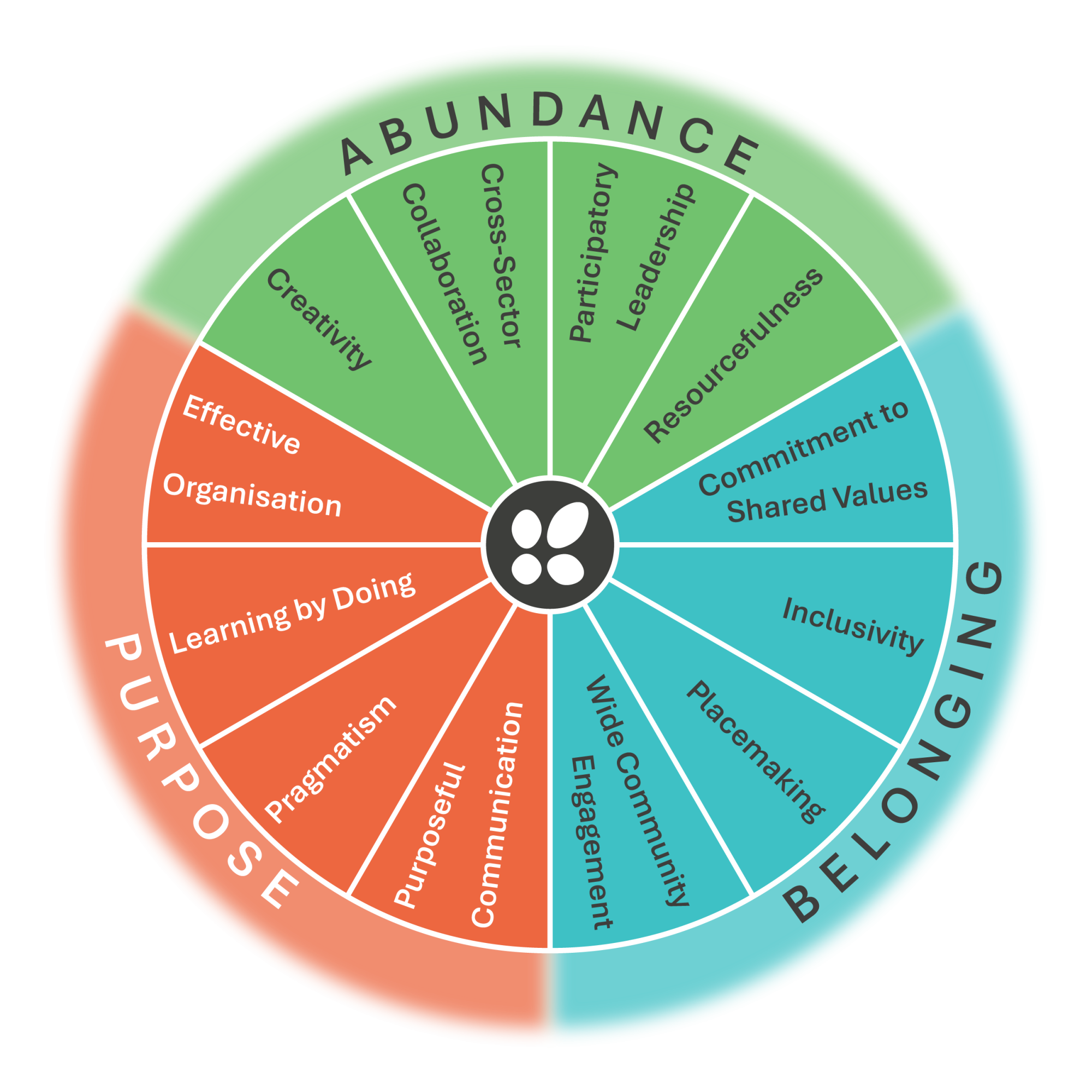
The notion of Abundance is about projects that may be cash-constrained relying instead on four other success factors: Creativity, Cross-Sector Collaboration, Participatory Leadership and Resourcefulness. (I have explored the equally powerful Belonging and Purpose characteristics in separate blogs – just click on the links.)
Clearly, having sufficient financial resources is a key enabler. But the secret of Abundance is not about financial resources. It is the mindset which has enabled all these projects to find ways around having only limited, or in some cases no funds at all!
As it says in the research report: “The mindset of Abundance is empowering because it shifts the focus away from constraints and scarcity to the almost limitless power of collective human energy.”
Or as Kate Collier, Bike Bus Project Lead at Bike Worcester puts it:
“I really love the concept of Abundance – it means so much for us as a small organisation that doesn’t have streams of money. We’re so rich in creativity, in people with ideas and love for the project. Also in people who are willing to help lead and to shape the development of other people involved in the project. It’s been really crucial that our Bike Bus Leaders have supported other people to step up, to be the next generation of Bike Bus Leaders, and to believe that they can do it in their community. That’s what Abundance means for us: being able to take that seed, that idea – the energy, buzz and creativity – and help empower others to bring all that into their area of Worcester.”
The research reveals that success is possible everywhere and the report has been put together as an action guide to help organisations of all types succeed in creating a bigger Changeprint. If you think these insights could support you in strengthening your existing project, or in creating a new successful collaboration in your area, do please download the report here.
FAQs
What does ‘abundance’ mean in local climate action?
Abundance in local climate action refers to a mindset that shifts the focus away from financial constraints and towards the strengths already present within a community. In the context of this research, abundance in local climate action is about recognising the value of creativity, collaboration, leadership and shared energy. Projects that embrace this mindset are able to move forward and create meaningful impact, even when funding is limited or unavailable. By focusing on what is possible rather than what is missing, communities can unlock new ideas, empower individuals to take ownership and build momentum that sustains long term environmental and social change.
How does the Changeprint concept differ from a carbon footprint?
The Changeprint concept differs from a carbon footprint by capturing the full range of positive outcomes created through climate action, rather than focusing solely on emissions reduction. While a carbon footprint measures environmental impact in terms of carbon output, Changeprint includes wider benefits such as improved public health, stronger local economies, increased social connection, educational opportunities and cultural value. This broader perspective helps organisations and communities understand the true impact of their work, making it easier to communicate success, build support and inspire further collective action.
What are the key characteristics of successful local climate projects?
The key characteristics of successful local climate projects, as identified in the research, are abundance, belonging and purpose. Each of these characteristics plays a distinct role in driving impact. Abundance encourages resourcefulness and creativity, belonging strengthens community engagement and shared ownership, and purpose provides clear direction and motivation. Together, these characteristics create a strong foundation for projects to grow and succeed. They also support the development of key success factors such as empowered leadership, wide collaboration and the ability to adapt and evolve over time.
Can climate projects succeed without significant funding?
Climate projects can succeed without significant funding when they are built on an abundance mindset and supported by strong community engagement. The research highlights that many high impact initiatives operate with limited or no financial resources, instead relying on resourcefulness, creativity and collaboration to achieve their goals. Empowered leaders play a crucial role in mobilising people, while shared purpose helps maintain momentum. By making the most of available skills, time and local networks, these projects demonstrate that meaningful progress can be achieved without large budgets.
How can organisations apply the findings from the Changeprint research?
Organisations can apply the findings from the Changeprint research by actively embedding the principles of abundance, belonging and purpose into their projects and strategies. This means prioritising collaboration, encouraging community participation and recognising the value of non financial resources such as skills, knowledge and local connections. The research can be used as a practical guide to help organisations strengthen existing initiatives or design new ones with greater impact. By focusing on collective action and broader benefits beyond carbon reduction, organisations can create more resilient, inclusive and effective climate projects that deliver lasting change.
Recommended from Carbon Copy
-

Out with the oil, in with the new!
A warming look back at our Community-to-Community Workshop with Swaffham Prior Heat Network What does it take for a rural…
-
Finding the plot
How did Hull become the first place in the UK with a legal Right to Grow? What does it actually…