Sharing the Warmth

How communities like yours could benefit from district heating systems.
District heating systems, also known as heat networks, provide heating and hot water to multiple homes and buildings from a shared source instead of each property relying on its own boiler or heating system. For rural communities that still depend on expensive, polluting heating oil, community heat networks could offer a cleaner and more reliable alternative.
Imagine houses across England kept warm through cold, wet winters by renewable energy that’s sourced locally and piped under the street to individual homes. You might think district heating is, well… a pipe dream. Or, if you’re familiar with the government’s new heat network zoning strategy, that it’s something reserved for large towns and cities. On both counts, think again.
About 800,000 households in England– many of them rural – still rely on oil for heating [Calculated using English Housing Survey 2023-4 and 2021 Census]. It’s messy, expensive, and bad for the environment, pushing out more emissions per unit of heat than even gas. And while homes on gas are protected to some extent by the energy price cap, oil prices are high and volatile, making heating oil users especially vulnerable to fuel poverty. It’s also unreliable, with householders expected to make sure their own fuel supplies remain topped up.
The government is aiming for heat networks to supply 20 per cent of England’s heat demand by 2050, a significant increase from the current 3 percent, focusing on major towns and cities. Rural communities are not included in this strategy. But thanks to the collaborative efforts of local community groups and councils, supported by energy co-operatives and charities, some rural communities up and down the country are already planning to create heat networks of their own.
Developing a community heat network can be complex, particularly when it comes to identifying suitable locations, funding and viable business models. The Community Heat Development Unit (CHDU) was an 18-month research and innovation project specifically set up to help communities explore these challenges.
It was specifically set up to help communities develop their own heat networks, using data to identify good locations and viable business models. It’s led by the Sharenergy cooperative, with partners Community Energy England, Marches Energy Advice (retrofit/insulation experts) and Carbon Alternatives (technical heat network design), with funding from the Energy Industry Voluntary Redress Scheme.
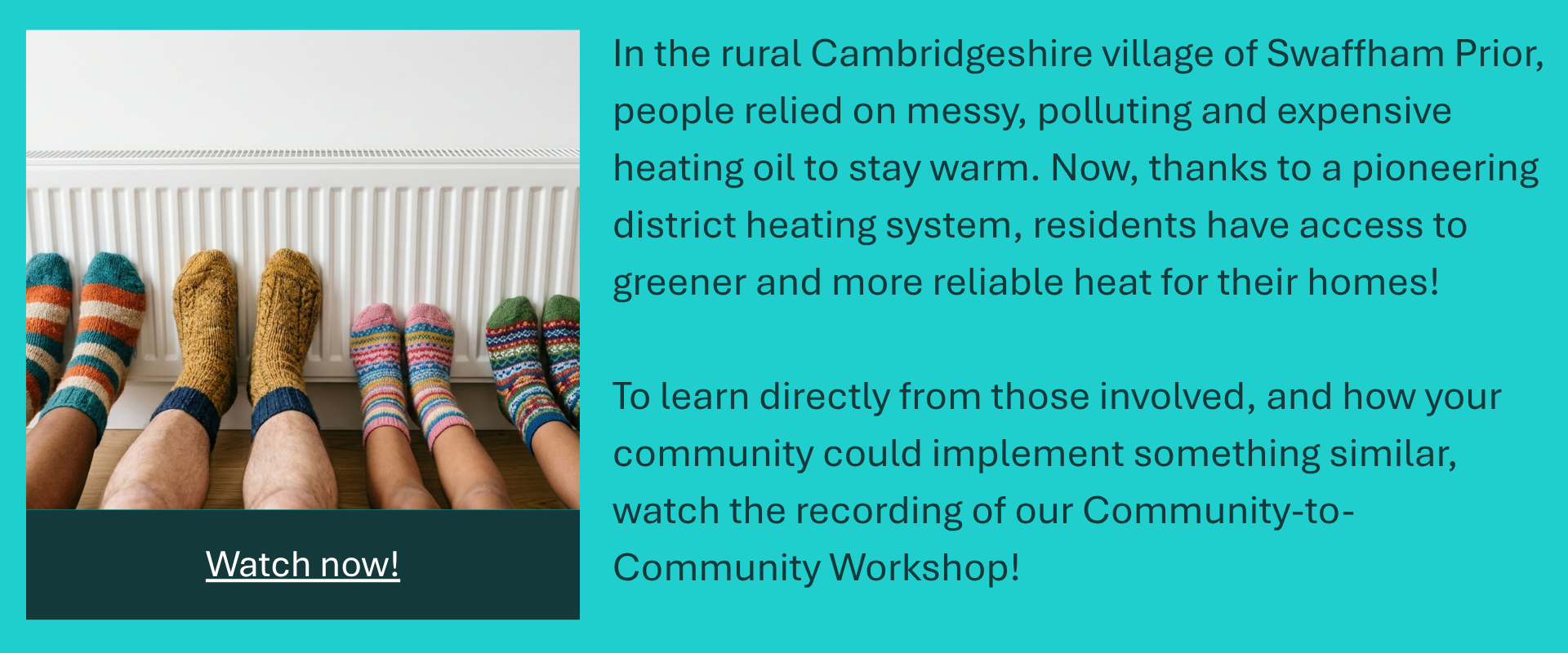
Swaffham Prior in East Cambridgeshire shows what a rural community heat network can look like in practice. Swaffham Prior Community Land Trust and Cambridgeshire County Council (CCC) have worked together to offer a green heating alternative to oil. Using ground source heat pumps with backup from electric boilers and a nearby solar farm, sustainable thermal energy is now being pumped under the streets into homes, with a commitment to connect nearly all the homes in the village to the scheme.
How are rural communities developing heat networks?
Swaffham Prior, the UK’s first rural heat network, is the pathfinder for a handful of other rural English communities in Northumberland, Staffordshire and Hertfordshire, which are now actively trying to clear the same feasibility and funding hurdles. The goal is affordable, dependable clean energy, and an end to fuel poverty.
No one is pretending it’s easy or straightforward. Bishop’s Castle in Shropshire has been pursuing a community wind turbine and heat pump heating network, run by Shropshire & Telford Community Energy, Sharenergy, and Lightfoot Enterprises. After winning planning permission for the 900kW community wind turbine in 2025, building that into a full heat network has proved much harder. The heat network side is currently stalled on funding and pipe costs.
Haydon Bridge in Northumberland is another pioneer village keen to promote the deployment of rural district heating owned by communities. The project, led by heat network consultancy Reheat, working with the rural community-support charity Community Action Northumberland and the Rural Design Centre, is at feasibility stage.
Bioregional, who led development of the BedZED eco-village and the One Planet Living sustainability framework, has worked with four local communities across England to explore the feasibility of developing community-led, net-zero-carbon compatible heating networks: Whittington and Fisherwick in Staffordshire; Shenstone in Staffordshire; Brightwell-cum-Sotwell in Oxfordshire, and Grand Union Community at Kings Langley in Hertfordshire.
What does a community heat network need to succeed?
Creating a successful community heat network involves much more than choosing a renewable heat source. Projects need to understand local energy demand, identify suitable sources of heat, develop a financially viable model and, crucially, secure support from the people who will use it.
Work with communities across England has included modelling the energy demand of existing buildings, exploring different local heat sources and developing technically and economically feasible solutions for community-wide heat networks.
Community engagement is equally important. Residents need to understand what a new heating system could mean for them, including potential benefits such as long-term price stability, lower-carbon energy, opportunities for local ownership and potential investment.
In many cases, local Climate Action Networks can provide the civic infrastructure that makes community energy projects possible: trusted local networks that can knock on doors, hold public meetings and build the kind of community buy-in that helped Swaffham Prior get its scheme over the line
Learn from Swaffham Prior
Carbon Copy hosted a Community-to-Community Workshop with representatives of Swaffham Prior Heat Network, who shared how they have successfully implemented their own renewable energy heat network. If you’re keen to explore how your community could do the same, then watch the recording, available online now!
What is district heating?
District heating is a system that supplies heat to multiple homes or buildings from a shared source. Rather than every property generating all its own heat through an individual boiler, heat is produced centrally and distributed through a network of insulated pipes. These systems are also commonly known as heat networks.
How does a district heating system work?
A district heating system generates heat from a central or shared source and distributes it to connected buildings through underground pipes. The source of heat varies between networks and can include technologies such as heat pumps and other low-carbon or renewable energy sources. Individual properties then use the heat supplied by the network for heating and hot water.
Can district heating work in rural communities?
District heating can work in rural communities where the location, number of properties, heat demand and available energy sources make a network viable. Swaffham Prior in Cambridgeshire demonstrates how a rural community can move away from individual oil heating towards a shared heat network. Other rural communities across England are now exploring whether similar approaches could work locally.
What are the benefits of community heat networks?
Community heat networks can provide a lower-carbon alternative to individual fossil fuel heating systems, depending on the source of energy used. Community-led models can also create opportunities for local ownership and greater involvement in how energy is generated and supplied. For communities dependent on heating oil, potential benefits can include more reliable heating and greater long-term price stability.
How can a community start a heat network?
Developing a community heat network usually begins by understanding local heat demand and exploring which sources of heat could work in the area. Communities also need to consider technical feasibility, costs, funding and the business model for operating the network. Building support among residents is particularly important because a community heat network needs enough properties to participate for the model to work effectively.
Recommended from Carbon Copy
-
From Footprint to Changeprint is making an impact
How do some local climate initiatives achieve remarkable impact? We think we have some of the answers. When Carbon Copy…
-
From Roots To Riverbanks
How joining up individual nature projects has much bigger benefits for communities and nature. Local nature-based solutions at a landscape…
-
Closing the Loop
How you can take a local economy full circle. A local circular economy keeps products, materials and resources in use for…
-

Local projects lead the way for others to create lasting positive change
We’re launching an innovative pilot series of Commmunity-to-Community Workshops to catalyse local climate action. With generous support from the National Lottery Community Fund,…