Finding the plot
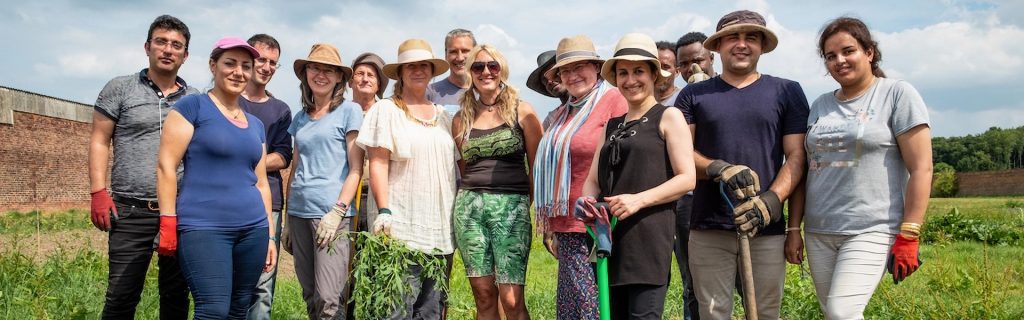
How did Hull become the first place in the UK with a legal Right to Grow?
What does it actually take to turn a community campaign into a legal right? At Carbon Copy’s second Community-to-Community Workshop, Space to Grow, host Roy Kareem sat down with Amie Watson and Darren Squires of Hull Food Partnership to find out.
Hull made headlines as the first place in the UK to turn “Right to Grow” from a nice idea into an enforceable policy — giving residents a genuine, workable route to growing food, and other plants, on unused council land.
It’s a story about community organising; slow and steady council progress, and the surprising power of food to bring people together across every political divide. Here’s what Amie and Darren shared, in their own words.
What is Hull Food Partnership?
“Food partnerships, in a nutshell, are exactly what they say in the title,” Amie explained. “It’s about bringing together the people that can help make change in that area.” Every food partnership is place-based, shaped by its own local context, but most are guided by the national Sustainable Food Places network and work to become a Sustainable Food Place in their own right.
Hull’s version began life years ago as Good Food Hull — a group simply enthusiastic about good food in the city. A council initiative later asked the organisation to formalise into a food partnership and apply for the Bronze Award; the first official recognition of a city committed to good food. That’s when, as Darren put it, the work “stopped being people sitting around talking about how great good food is,” and they “got the opportunity to start doing something about it.” Today, Amie works as Community Food Support Officer and Darren as Campaigns and Projects Officer, working across the city’s many food-related strands at once.
How Amie and Darren ended up working in food
Neither Amie nor Darren set out to build a career in food. Amie previously worked in fashion and textiles. “I hated the fashion industry,” she said plainly. “I hated the way that the industry was destroying everything.” During lockdown, as food co-operatives started springing up, she got drawn into saving surplus food from the bin — and then, more importantly, getting it to the people who needed it. “I didn’t particularly choose to go into food, but it sort of chose me,” she said.
Darren’s route was even more unlikely. Short on video projects during lockdown, he started making content about the importance of vegetables — and ended up interviewing someone from Hull Food Partnership for one of his videos. Months later, a chance meeting at a community event led to a job offer doing, in person, much the same thing he’d been doing to camera.
Why food is the great connector
One theme ran through the whole conversation: food has a rare ability to bring people together across divides that usually keep them apart. “As soon as you mention there’s going to be food at the event, everybody wants to come,” Amie said. “We all need to eat — there’s no mistaking that.”
Darren has seen this play out in surprising ways. “I think one of the reasons why it’s politically neutral is because it feeds into anybody’s political philosophy; everything from the rugged individual to collective action,” he said. When Hull’s Right to Grow policy hit the media, it was covered by Dutch TV and by a wide range of YouTube channels; commentators who, by their own politics, were “the last people” you’d expect to champion a policy brought in by councillors they’d never vote for. And yet, he said, “they thought it was a fantastic idea.”
On how to turn that goodwill into action, Amie is a firm believer in showing rather than telling. “The more you try and get people revved up to try and do something, the less likely they are to do it,” she said. Instead, she focuses on demonstrating what’s possible: a growing project, a community fridge, a cafe, so people can see change happening in front of them. “If you can see something happening and changing before you… you can believe that it’s possible.”
From protest to policy: the birth of Right to Grow
Right to Grow is, in Darren’s words, “a presumption on council land that if it’s not being used for anything else and it’s suitable, you should be able to get a licence to grow on there.” Hull wasn’t the first place to have a Right to Grow on paper — but theirs was the first that actually worked, because community groups kept pushing for something that was genuinely deliverable.
The breakthrough came at a food hustings event, where a councillor told the community growers campaigning for change: write the motion, and I’ll bring it to council. A councillor from a different, ruling party then offered to second it and Darren credits Incredible Edible, the national movement behind the original community Right to Grow campaign, for bringing their know-how in from outside the city. The motion passed unanimously, a rare event in local politics.
But a vote alone changes nothing. “Any council resolution that doesn’t have a mechanism for delivery is just a resolution,” Darren warned, comparing it to Sheffield’s old “nuclear free zone” declaration — symbolically nice, legally meaningless. Hull’s community groups understood that passing the motion was only step one.
Making it real: Six months to build a legal mechanism
The early plan was to map every plot of available council land in advance. In reality, this was simply not feasible. Darren described chasing a mythical master map (“nobody knew quite where it was”) which, in the end, turned out not to exist. Mapping land to the granularity needed (some applicants wanted to grow on as little as four square feet) would have been prohibitively expensive and complex for a compact city like Hull with no suburbs.
So they built something simpler: a legal presumption in favour of growing, with a case-by-case licence process instead of a pre-approved map. Over six months, Hull brought together council officers, councillors, co-opted members and expert witnesses to work out exactly how the policy would function in practice — consulting the legal team on liability, highways on sight-lines and road safety, and health and safety on soil testing. The result is a process any resident can start today: identify a plot of apparent council land, submit photos through the council website, and work with a named council officer who checks ownership and resolves any snags until an applicant ends up with a licence spelling out exactly what they can and can’t do.
Where Right to Grow stands today
Around 18 months after the system went live, roughly 14 groups have applied. A couple of plots turned out not to be council land after all and are being redirected to alternatives; the rest are working through the process, including the neighbourly diplomacy of informing nearby residents — not everyone is thrilled to see a patch of lawn turned into wildflowers and vegetables. Two sites are now well and truly up and running, and Darren is hopeful that this will have extended to around a dozen by the end of the growing season.
His advice to anyone expecting instant results: don’t. “Don’t expect it to be a quick process if it’s going to be done properly,” he said. “What you need to do is spend as long as it takes to get it through the council as a mechanism, and then when people start applying it, it goes at a pace — and it will speed up.” The slowness isn’t obstruction, he’s keen to stress, just the ordinary pace of council working through something genuinely new.
What’s replicable: lessons for other communities
Asked what other communities could realistically copy, Amie and Darren were careful to say not everything translates directly — but several principles clearly do:
- Find or build a food partnership. “If you haven’t got a food partnership, I would look to get one,” Darren said, to bridge the gap between community groups and council officers who might otherwise never hear each other.
- Build real community backing first. Darren described a cautionary case elsewhere where a council officer picked a site for a community garden without telling the community who’d be using it — it went nowhere. “You can’t impose it.”
- Work with the council, not just at it. “We’ve had a Right to Grow that hasn’t worked, and we’ve got a Right to Grow that does,” Darren said. “The difference: we worked with the council to make it work.”
- Tell the story the council needs to hear. Whether it’s saving money, empowering residents, or building community, Darren’s view is simple: “all of those stories” are true at once — so tell whichever one lands.
- Show, don’t tell. As Amie put it, demonstrating a working project persuades people far more effectively than trying to talk them into enthusiasm.
Get involved
For anyone wanting to go deeper, Carbon Copy is recording a podcast episode with Hull Food Partnership exploring the story further — including the day-to-day projects and partnerships that don’t always make it into a single conversation.
Watch the full workshop recording below and keep your eyes and ear peeled for the podcast episode when it lands.
Recommended from Carbon Copy
-

Out with the oil, in with the new!
A warming look back at our Community-to-Community Workshop with Swaffham Prior Heat Network What does it take for a rural…
-
Refuse, reduce, repair, repurpose, recycle – recap!
Circling back to our Community-to-Community Workshop with Circular Malton & Norton How long does it take to move people to…
-
From Footprint to Changeprint is making an impact
How do some local climate initiatives achieve remarkable impact? We think we have some of the answers. When Carbon Copy…
-

From Roots To Riverbanks
How joining up individual nature projects has much bigger benefits for communities and nature. Local nature-based solutions at a landscape…