Refuse, reduce, repair, repurpose, recycle – recap!
Circling back to our Community-to-Community Workshop with Circular Malton & Norton
How long does it take to move people to act? Well, based on our recent experience as hosts of Closing the Loop, the first in our series of Community-to-Community Workshops – roughly 90 minutes! At the end of the session, an incredible two-thirds of attendees said they were ready to try something new with their project.
Led by facilitator Roy Kareem, with guest speaker Sue Jefferson, co-founder and chair of Circular Malton & Norton, the session took place online on Tuesday 29 September.
Over the course of the evening, Sue told the story of how a small group of volunteers in rural North Yorkshire set out to build a genuinely circular economy town — one with no waste, thriving local businesses, and a community that actually wants to get involved. It’s a story with real setbacks, a near-implosion, and more than one unconventional idea (jam jars, anyone?). Here’s what came out of the conversation, in Sue’s own words.
What is Circular Malton & Norton?
Circular Malton & Norton is a grassroots initiative working to turn two neighbouring market towns in rural North Yorkshire into what Sue simply calls “a circular town” — one with no waste, where businesses and communities are thriving because everyone’s saving money, and where good green jobs mean local young people don’t have to move away to build a career.
Sue co-founded the organisation after a career in corporate strategy, marketing, innovation and manufacturing. “Kind of change management is my background,” she explained — and that transformation mindset is exactly what she turned towards climate action closer to home.
From climate overwhelm to a town-wide experiment.
Sue didn’t start out as a climate campaigner. She described feeling “really kind of upset and quite overwhelmed” by climate change, and “really helpless” about what she personally could do — until she came across the circular economy as a model that wasn’t exclusionary: not just for people who could afford it, and carrying social and economic benefits alongside the environmental ones.
That reframing led to a simple, bold question: “What if we created a circular economy town in rural North Yorkshire?” Market towns like Malton and Norton, she explained, carry many of the same pressures as cities — declining high streets, low-paid jobs, empty shops — plus extra rural challenges like limited transport.
Speaking to the “hesitant majority.”
One of the most useful ideas Sue shared was the concept of the hesitant majority: people who, as she put it, are “wanting to do something but are not.” Not out of apathy, but because, as she suspected, “life gets in the way.” Reaching that group, she argued, means roughly 70% of people need a completely different kind of invitation than the one typical environmental messaging offers.
The approach Circular Malton & Norton settled on was purposeful communication: no jargon, and often no mention of “the environment” at all, at least not at first. Conversations start with something more immediate instead — making a difference, saving money on energy bills, cutting down on waste — and letting people’s own curiosity do the rest.
Crucially, that honesty extends to admitting imperfection. One of Sue’s go-to lines when meeting people is disarmingly simple: “It takes all my effort to wash my yoghurt pots and put it in the right recycle bin.” People’s “shoulders relax” when they hear it, she says — they’re not being preached at, they’re being met as equals. It turned out to be true inside the organisation too: when the volunteer group measured their own carbon footprints, Sue admitted, “we found we were all above average.”
Turning a high street shop into a circular hub.
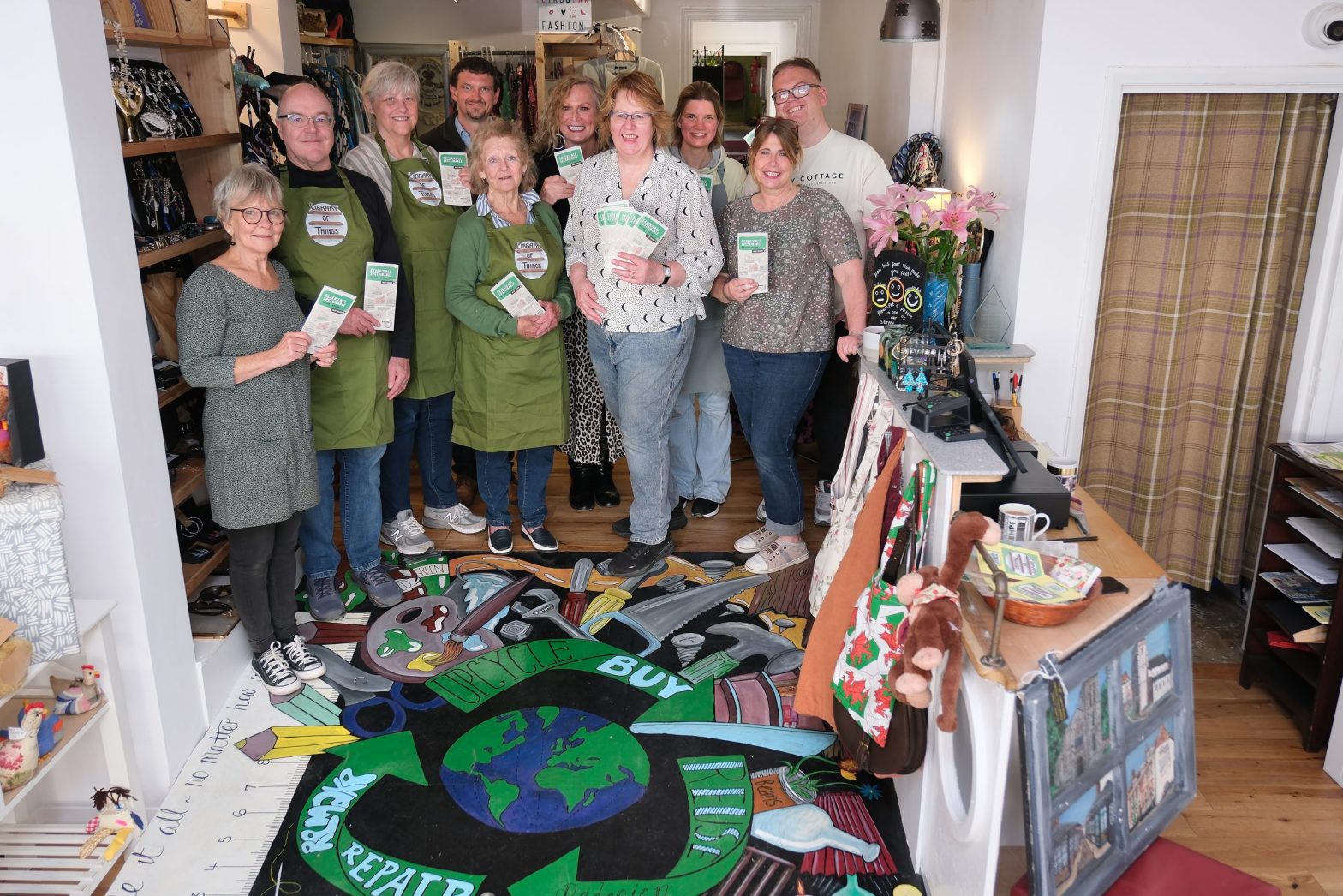
Belonging to a place, Sue found, had to be built — it didn’t exist as a slogan. The turning point was “Ryedale Remakes”, an upcycling shop and studio inspired by BBC daytime TV’s Money for Nothing, where discarded items get turned into something desirable. It launched in “a very tiny place with no heating at all,” staffed by volunteers with upcycling skills Sue didn’t have herself — she simply put a call out to the town for anyone who did.
Against the odds, it became a genuine destination. The project has since moved to premises on the high street, rebranded as a circular hub, deliberately avoiding the look of a typical environmental project. Instead, an eye-catching window of upcycled furniture and items does the work of drawing people in. As Sue put it: “It’s a bit like a spider’s web. Once they’re in, we kind of go, let us tell you a bit more.”
Three strands of change: energy, enterprise and everyday habits.
As the organisation matured, its work settled into three parallel strands. The first is everyday high-street engagement: free fridges for surplus food, a Library of Things, and the shop itself, all lowering the barrier to getting involved. The second is an ambitious energy project — a community anaerobic digester that would turn local food waste into energy for nearby buildings instead of sending it to landfill or the grid. Three years in, it secured planning permission with no objections whatsoever, “a first in the whole anaerobic digester industry” according to Sue, and has since expanded into plans for renewables and a decarbonised, off-grid business park, backed by interest from private investors and GB Energy.
The third strand is a business hub, helping local companies move past the sense that it’s “profit versus planet” and find a practical first step. Running all three in parallel matters to funders too, Sue noted: what both government and private investors want to see is something “scalable and replicable,” not a one-off.
Growing pains: “We’d got a tiger by the tail.”
Rapid success brought its own problems. “We were kind of growing so fast and so quickly,” Sue said, with more volunteers, more projects and more to report on “and frankly, we were falling over.” From the outside, the organisation looked like a success story; from the inside, she admitted, “we felt we were at risk of imploding”: the classic start-up-to-scale-up squeeze, or as she memorably put it, “we’d got a tiger by the tail.”
The fix started with honest conversation — first with the board, then with volunteers who felt lost amid the growth. Sue credits one piece of change-management advice in particular: “Don’t ask what’s wrong, because you’re just going to get a whole list of stuff… if you ask what’s missing, people really work out what is missing.” The answers (better communication, more input into decisions, a clearer sense of the bigger ambition) fed into one of the most important pieces of work the organisation did: a facilitated workshop that distilled very different language from very different volunteers into five shared values, now used as a filter for anyone joining the team, staff and volunteers alike.
Measuring impact with three jars and a handful of pebbles.
With no budget for research and no obvious way to measure whether any of this was working, Circular Malton & Norton borrowed an idea familiar from motorway service stations: the three smiley-face buttons. They set up three jars, each labelled with how a visit to the shop had made someone feel; “no different,” “happier,” or “inspired to act,” and let visitors drop in a donated pebble.
The results surprised even Sue: 72% of people chose “inspired to act.” That simple piece of evidence did double duty. It gave her something concrete to show funders, government contacts and local authorities, proving the project was reaching people who wanted to do something but didn’t know where to start. And it directly inspired a new initiative, the Inspired to Act programme: a booklet and website calendar signposting everything already happening locally, from repair cafes to volunteering opportunities, organised simply around whether someone wants to make, repair, live more consciously, or help shape change.
Key takeaways for community climate projects.
Sue’s advice, distilled, is useful well beyond one Yorkshire market town:
- Be bold with your asks. Workshop participants reflected that bigger, more confident requests to funders, landowners and partners tend to land better than small, hedged ones — confidence in the project reads as confidence in the person being asked.
- Don’t skip the values work. A facilitated exercise to agree shared values, even years into a project, can be “one of the most important pieces of work” an organisation does.
- Use the support that already exists. Sue leaned on regional networks like Community First Yorkshire for help with funding applications, alongside sources such as National Lottery Awards for All and Net Zero Hubs for energy projects.
- Lead with money, not morality. As Sue put it: “We don’t have to talk about the climate… we talk about this being a way to save money and be good to the planet,” adding that the real trick is “making it cool and fun to do that.”
- Expect it to be a labour of love. “It’s a roller coaster because it’s highs and lows,” Sue said — so it helps to be clear on your own why, whatever that is.
Get Involved
If this has struck a chord — whether you’re just starting out or working through your own growing pains — Sue has said she’s happy to hear from people via the Circular Malton & Norton website.
Watch the full recording, below.
Recommended from Carbon Copy
-
From Footprint to Changeprint is making an impact
How do some local climate initiatives achieve remarkable impact? We think we have some of the answers. When Carbon Copy…
-
From Roots To Riverbanks
How joining up individual nature projects has much bigger benefits for communities and nature. Local nature-based solutions at a landscape…
-
Closing the Loop
How you can take a local economy full circle. A local circular economy keeps products, materials and resources in use for…
-

Local projects lead the way for others to create lasting positive change
We’re launching an innovative pilot series of Commmunity-to-Community Workshops to catalyse local climate action. With generous support from the National Lottery Community Fund,…