From Footprint to Changeprint
How do some local climate initiatives create such remarkable impact? Find out with Carbon Copy founder Ric Casale and Eunomia research consultant Izzy Williamson.
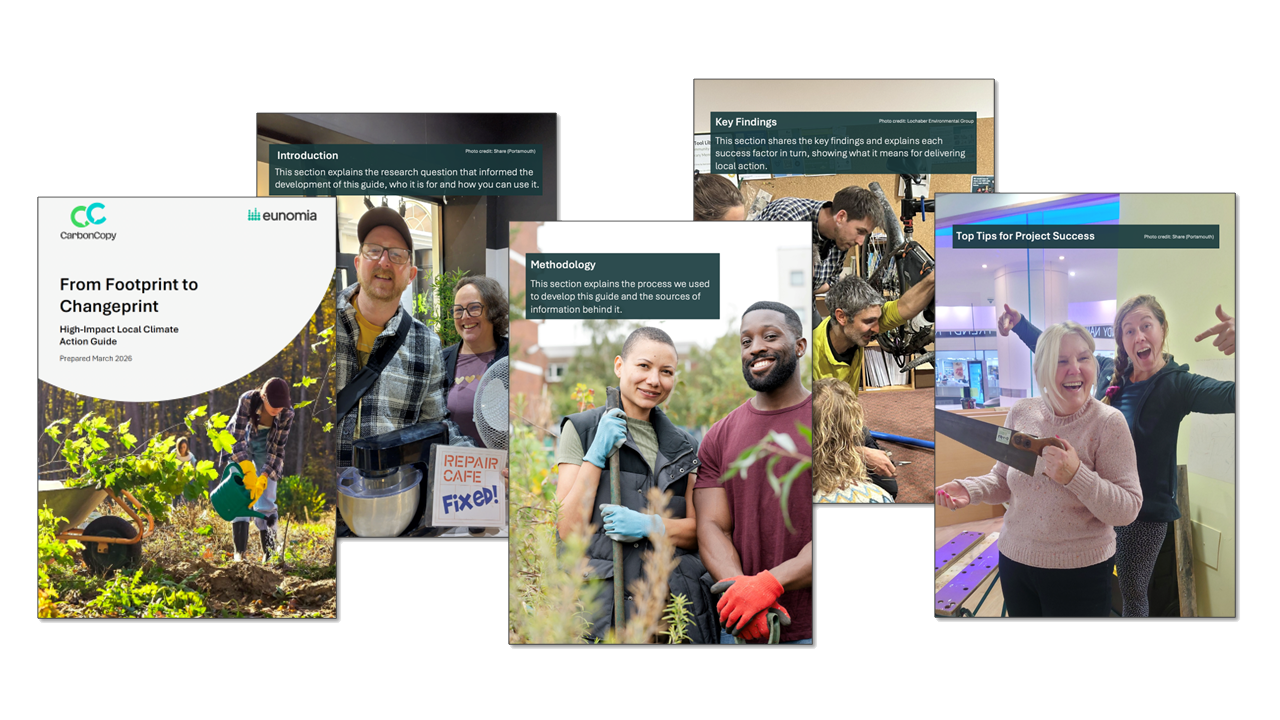
In this episode of the Carbon Copy Podcast, recorded at the launch event for our new report: “From Footprint to Changeprint,” we explore the key characteristics and success factors shared by high-impact place-based initiatives from across the UK. Hosted by Carbon Copy founder Ric Casale and Eunomia consultant Izzy Williamson, the episode delves into the methodology behind the research, reveals some of the key findings; and spotlights examples from some of the participants whose organisations supported the study.
Listen now to:
- Learn what we mean by a Changeprint, and why we think this new way of talking about impact could spark inspiration.
- Gain insight into the 12 success factors of local climate action, and how they work together within three broader characteristics.
- Hear about some of the high-impact projects involved in the research, and how the success factors and characteristics relate to their work.
- Discover how to access the report and guide, and how this could help you and your organisation grow a bigger Changeprint.
Show notes
This episode of the podcast was written and hosted by Ric Casale, Founder of Carbon Copy and Isabelle Williamson, Consultant at Eunomia. It was produced and edited by Bradley Ingham. Thanks to Kate Collier, Simon Gray and Clare Seek for their participation and to all the other representatives of local climate initiatives who contributed to the research.
- Access a copy of the report From Footprint to Changeprint: https://carboncopy.eco/changeprint/report
- Find out more about Changeprint: https://carboncopy.eco/changeprint
- Learn more about Eunomia: https://eunomia.eco/
- Read about Bike Worcester on Carbon Copy: https://carboncopy.eco/initiatives/bike-worcester
- Read about Ulster Wildlife’s Haughey’s Bog restoration project on Carbon Copy: https://carboncopy.eco/initiatives/haugheys-bog-restoration
- Read about Share (Portsmouth) on Carbon Copy: https://carboncopy.eco/initiatives/share-portsmouth
- Listen to other episodes of the Carbon Copy Podcast: https://carboncopy.eco/podcast
- Send us an email: [email protected]
Podcast transcript – click to read
[Intro music]
Ric: Hi, I’m Ric Casale, I’m one of the co-founders of Carbon Copy. We are a Climate Action charity focused on UK climate action. And as a charity we exist to take individual concern for the climate and turn it into collective impact.
Izzy: Hi, I’m Izzy Williamson, I’m a consultant at Eunomia. We are a global sustainability consultancy. We are a B Corp business, we are about 150 employees across five offices and we work across carbon, circular and natural economy projects.
Ric: We’re here today to share findings from a brand-new report called From Footprint to Changeprint. And this is a report that was commissioned by Carbon Copy, but led by Eunomia: Izzy and lots of other team members. And it builds on a year-long campaign that Carbon Copy ran last year called 25 Big Local Actions in 2025.
Izzy: Thanks for that, Ric. Would you like to explain the title of the report, From Footprint to Changeprint?
Ric: So we’re all pretty familiar with the concept of personal carbon footprint, which is essentially our individual carbon emissions or our organisation’s carbon emissions. And the duty, the responsibility, in many cases an individual kind of like the guilt of trying to reduce your carbon emissions. But the issue is that it’s too reductionist. It just focuses on this one element. And climate action doesn’t have to be all about carbon emissions. There’s many more things that happen when we take collective action, many more positive benefits that are not captured in this one metric. Things like health and wellness benefits, both individually and more widely. You can create more jobs, thriving nature. There’s a whole host of benefits that comes with collective action. What we wanted to do with this idea of Changeprint is to have a way of capturing all those positive impacts and being able to describe it relatively simply and to also make all those impacts more visible.
Think beyond footprint to Changeprint. The benefits, we don’t want to leave them hanging in the air, bring them closer to home.
Izzy: Brilliant, thank you.
Ric: Do you want to talk a little bit about the design of the research?
Izzy: So we were looking to identify the core characteristics and success factors of high impact, place-based action on climate and nature. And we’re looking to create a guide that would support change makers, be they local councils, community groups, schools, volunteers, small businesses, to help increase or grow their Changeprint. And so the guide includes a range of definitions for success factors, explanations, some case studies, and as well as some top tips for success according to each of those success factors.
Ric: Can you give us a bit of an idea of, I’m sort of looking at a bit of a chart that talks about sampling. What do you mean by sampling and how many first kinds of numbers that were involved in this?
Izzy: Yeah, of course. So we started off the research with a sampling activity. And through that, we long listed about 162 projects across the UK and across the Big Local Action themes. And from there, we then shortlisted the case studies into about 15. And we wanted to achieve a nice cross section of those case studies across different geographies, scales, project theme, as well as a wider range of factors such as funding levels, type of change makers involved, scale.
So we had our 15 case studies and we reached out to participants and change makers involved in those case studies. And we ran about 27 interviews with a range of representatives. And from those interviews, we really wanted to get an insight into what the success factors were for those projects and how and why they were success factors. So we followed that then with a survey. And in that survey, we listed the success factors we were seeing coming out of the interviews and looked to identify the relevance and the importance of those success factors. We then took all of the data from our interviews and surveys and analysed those. We did use a software to support us with the thematic analysis. And then we drew out some key insights, which are now summarised in the report.
Ric: It is, to my mind, a very comprehensive report. I think what you just said at the end is that a lot of the interviews were substantiated with some quantitative analysis, which gives a very robust level of detail. And yet you’ve managed to distill some pretty powerful findings here. So do you want to just talk us through the summary?
Izzy: So we firstly found that the results were consistent across the UK and a wide variety of project types, indicating that success isn’t limited to certain places or project types or change makers involved, or necessarily those with the most amount of financial resources.
We then found that success factors can be copied. So they weren’t unique to any one project. And actually they spanned all of the case studies. So that then enabled us to develop a set of top tips for each of the success factors for others to copy what’s working. We then found a lot of overlap between the success factors, which led us to then grouping the success factors into three overarching characteristics, Abundance, Belonging, and Purpose. And these aim to bring together the interconnected nature of the success factors.
We then found that one size doesn’t fit all. So Effective Organisation did come out consistently as a really important success factor. But the relative importance of individual success factors did vary according to the case study. And to us, this reflected the diversity of local challenges and opportunities in different areas and projects, and highlighting that flexible approaches are actually often the most successful.
Then we found that combinations of success factors are really important rather than one in isolation. So highlighting that a range of skills and focuses is really important. And then finally, we found that where a project is based or what the project is on or the type of community involved actually doesn’t determine its success. And instead, two key things that really came out to us is important were firstly how projects collaborate, adapt, and organise themselves. And secondly, how rooted they are in the place and the community. So really reflecting that sense of trust, relationship building, and belonging.
Ric: I think that one of the most powerful findings from my perspective and from Carbon Copy’s perspective is that success can be copied at a local level across the UK. And I think literally that means that where we are, we can turn where we are almost into the seat of the solution, which is very empowering.
Let’s have a look at these kind of success factors and these characteristics that you were talking about. We can identify three core characteristics, this notion of a mindset of abundance, a strong sense of belonging, and a purposeful approach. And that beneath these almost, there are 12 success factors that correlate more strongly with certain characteristics.
And to my mind, in combination, they sort of represent this virtuous circle whereby you can increase benefits, you can increase impact, and it just continues because they are self-reinforcing. And because they can be copied, we don’t have to reinvent the wheel. No pun intended, but it’s there. So it’s something that people can take away and do something very constructively with.
So what I’d love to do, because you were very close to this research, is perhaps we can go through each of these three core characteristics, get a bit of a better understanding as to what that characteristic is about, and then maybe some of the key success factors that line up with it.
Izzy: So our first characteristic is Abundance. And Abundance captures the abundance of energy, leadership, skills, creativity that you might have in a project. And we found that this was a really important characteristic for successful projects, particularly in places that are underfunded or under-resourced. I think it’s really quite an inspiring characteristic because it helps shift the mindset from scarcity and constraint to a sense of limitless power if you have that abundance.
And so we identified four success factors under this, the first being Creativity. So engaging imagination and expression in your dialogue, communications, and action. And this can help translate your project values into something that’s personally relatable for people. So we saw some quite nice examples of film and art being used.
We then had Cross-Sector Collaboration, which reflects valuing the overlap and interaction between different parties that you might have involved in your project. So a lot of this is about encouraging diversity of participation, bringing those different views together to then come up with something much greater.
Then we had Participatory Leadership. So seeing an abundance of leaders in your project and empowering them to take action, whether that might be volunteers or those in your project team, and instilling confidence in them as catalysts of change.
Ric: Is that idea not just looking at people with formal leadership positions or with titles in a particular organisation, but just recognising that a lot more people can play a leadership role?
Izzy: Absolutely, yeah. Recognising that anyone could be a leader.
We then had Resourcefulness. So this was about doing more with less and capturing the human energy skills and partnerships to amplify your impact. And this applied to both operations and communications, but it also related to being adaptable and learning as you go.
Ric: You know, as you set it up, this notion or mindset of Abundance is very counterintuitive, when we were looking in places that were perhaps underfunded or didn’t have enough funds. And where funding is a challenge for all of us, all our projects across the country. And so I don’t think we’re saying for one moment that funding is not important. It is. It is a key enabler and it remains a key enabler. But in looking at what else can deliver high impact, having that kind of mindset seems to unlock a lot of resources that perhaps are overlooked if we think too much about one particular resource, i.e. cash.
Izzy: Absolutely. And I think that’s exactly why this characteristic in particular is so inspiring and should be empowering.
Ric: So what we have for everybody here is we wanted to bring each of these characteristics to life a little bit through the words of some of the participating projects in this research. The first is Bike Worcester. And Bike Worcester is a community-led organisation that promotes cycling, active travel and safer streets across Worcester. Here’s Kate Collier that’s going to talk about one of their particular initiatives called Bike Bus Worcester.
Kate: I’m Kate Collier. I’m from Bike Worcester. I’m the Bike Bus Project Lead. Bike buses are a safe and a fun way for children to get to school together. So the Bike Bus Project involves school communities choosing a route that would help families travel together by bike. And then making that happen. Like a bus, we have lots of stops along the way. And it’s a way for families and caregivers and children to take part in something which is fun, which is safe, and which is helping with air quality and doing our little bit for climate change.
I really love the concept of Abundance in this project because it means so much for us as a small organisation. From the sense of being an organisation that doesn’t have streams of money coming towards us. We don’t have lots of funding or resources in that sense. But we are so rich in creativity, in people with ideas and love for the project. But also people who are willing to help lead others and shape the development of other people in the project. So for us, it’s been really crucial that our Bike Bus Leaders have been able to support other people, to step up and be the next generation of Bike Bus Leaders, and to believe that they can do it in their community. And that’s what Abundance really does mean for us, is being able to take that seed, take the idea, take the energy, the buzz and the creativity, and to help others feel empowered to bring that into their area of Worcester and to bring the project to life for themselves and their community.
Ric: That’s a really a great endorsement from Kate in terms of how that has helped inspire what she does. I think my takeaway is, if you don’t have this abundance of cash, there is an abundance of other resources. You just need to think a bit more widely about what are some of the other resources that can help put a plan into action or help implement a particular project. Do you want to talk to the second core characteristic of a sense of Belonging?
Izzy: Yeah, so Belonging captures how projects can thrive when they’re truly connected to the places and communities that they’re operating within. And that might involve really discovering and valuing what matters to people and building on that shared sense of belonging and identity of a place. And it involves that feeling of connectedness to a place or community and the social ties that can accompany that can support more effective collaboration as well as resilience within a project over time. And the four success factors that we grouped within this characteristic firstly includes commitment to Shared Values. So a common understanding that climate action is critical and has tangible, wider community benefits as well.
And Shared Values can help a project centre itself and enable consistent messaging and alignment with a shared purpose and mission towards that common goal.
We then had Inclusivity. So this captures the active involvement of all voices that you might have involved in your project, showing people that their voice matters and that their needs will be met. And as well as that, we also saw it being about equal access, representation and fair decision making within the operation of the project as well.
Then we had Placemaking. So this is the creation of a shared sense of belonging and pride in the place. And that is an active process. So we typically involve creating, shaping and maintaining often a physical hub for convening people and communities. So to create that focal point for activity.
And then finally, we had Wide Community Engagement. So this is with multiple and diverse members of a community achieving high levels of participation and awareness among them. And that could be with volunteers, funders, project partners, your team, charities and the wider public.
Ric: There’s one thing actually just thoughts come to my mind in listening to you now, which is there’s this difference between climate mitigation and climate adaptation, where the mitigation is drawing down atmospheric carbon and the adaptation is obviously adapting to our changing climate. And climate adaptation is intensely place-based because it affects different places very differently. And so I wonder of these three characteristics, whether this sense of Belonging and importance of place is vital when we think about what needs to be done from a climate adaptation perspective.
Absolutely. I think it’s recognising the power of place. And I think that really shines through in the case studies and the report actually of how that sense of Belonging, pride in place, shared identity can be such a catalyst for action and bring people together, provide motivation. It’s hugely powerful, I think, and can be in many different ways.
Ric: Yeah, because that sense of place can be either identity with other people within the community. So it can be very much a human connection. It can be to your point, a physical one with landmarks, with community hubs, etc. Or it can be with nature and the natural environment within that space. And I think that’s a nice segue to our second project because that is very much a nature based one. We hear from Simon Gray, who’s from Ulster Wildlife. And this partnership project has been so successful. It’s become Northern Ireland’s first demonstrator pilot for how to restore peatlands. So let’s hear what Simon has to say.
Simon: My name is Simon Gray. I’m the Head of Peatland Recovery at Ulster Wildlife. And Ulster Wildlife, along with An Creagán, manage the Haughey’s Bog project in County Tyrone, just in between Omagh and Cookstown there, which is a peatland restoration project, which combines a lot of environmental education, awareness raising and restoration work on the ground. So An Creagán is a community funded organisation.
And they have been based in that area around the corner from Haughey’s Bog for 30 years now. And they are, you know, owned, managed and directed by members of that community, all of which live within literally one or two miles. And many of the people that work in there are from the very immediate area. So I think that was a key lesson for us, that was that, you know, if there’s a community organisation which is already thought those connections well embedded within that landscape and has, again, the shared values, which An Creagán do to Ulster Wildlife, then there’s no point in trying to replicate it, you may as well just team up and work together.
And that has been definitely the biggest strength when it comes to this project. But also then, when it comes to, say, delivering and developing things like events and interpretation, all those sorts of things, we’ve tried to make this project as hyper-local as we possibly can.
You know, we, Ulster Wildlife does a lot of peatland restoration work across the whole of Northern Ireland. And generally, we talk in more kind of big picture terms. If we’re working in certain areas, we’ll talk about, you know, the global context of peatlands and the benefits that they will bring, you know, national scale in Northern Ireland in terms of water quality or carbon storage, whatever it is. But at An Creagán and at Haughey’s, we’ve really recognised that there is a want and an interest there to know about that place particularly.
And so we’ve tried our best in order to actually showcase and talk about specific places. We’re doing this project with Queen’s where they’re actually taking peat course from the bog there. And they’re going to be able to say, not just what the environment across like the Sperrins or Northern Ireland looked like 13,000 years ago or 5,000 years ago, they’re going to be able to say, this is what this place, this exact place that you live in, looked like 5,000 years ago.
Ric: So I think what really comes across is that importance of place and how that’s essentially the glue that’s sticking people together. Last but not least, the third and final characteristic.
Izzy: Yeah, absolutely. So the third characteristic is a Purposeful attitude, which reflects how projects are most powerful when they’re highly organised, filled with practical purpose built on experience and focused on local real-world needs and opportunities. And this is actually less about overall mission and more about the drive to make real change and being purposeful in organising people, resources and your communication. It does also include an element of learning from mistakes and being adaptable and willing to learn as you go.
And so the four success factors we’ve got under this umbrella firstly includes Effective Organisation. So having clear roles, delegated leadership, strategic planning and oversight and an efficient use of resources. This really shone through as an important success factor. And it could involve keeping a team aligned with clear responsibilities and regular engagement.
The second one is Learning By Doing. And this is about being open minded and acting on feedback and a commitment to continuous learning. And that might involve drawing on experts who have done similar work before or elsewhere at the same time.
Then we have Pragmatism. And this is about understanding your limits and influence and often valuing that steady incremental progress, which might involve moving with some patience and adaptability, but while always staying rooted in mission.
And then finally, we had Purposeful Communication. So this includes purposeful and tailored communications to a wide range of audiences, supporting their engagement, discussion and actions. And this recognises the importance of communication for trust, relationship building, participation and impact. Yeah, very symbiotic success factors actually under this one, I think. There’s a lot of overlap.
Ric: And one of the ones that sticks out for me is this idea of learning by doing almost like this bias for action. I’m not getting quagmire. There’s this “paralysis by analysis” and this idea of the plan has to be perfect. And this is much more oriented around doers and doing, and having that willingness to make those mistakes because they’re valuable and they’re learning opportunities and then moving forward. So it’s quite iterative. And what keeps you on track is the big mission or purpose at a high level. But what you’re saying here, which is a difference is the attitude, the mindset of being purposeful and a certain determination to just get there.
Izzy: Absolutely. And I think recognising that even if you’re having or what feels like a small impact, it is still impact. And you’ve got to start from somewhere and actually that can then grow. But recognising and valuing that even if you might have only reached a few individuals, it’s still having a Changeprint of some sort.
Ric: And that’s how you build momentum.
Izzy: Exactly.
Ric: So we have that final clip. This one is shared by Share (Portsmouth), is the name of the organisation. They run a repair cafe and a Library of Things to make it easier for people to reduce waste, raw material usage, and obviously carbon emissions through sharing, repairing and reuse. Clare Seek helps articulate what a Purposeful approach actually looks like in practice.
Clare: So I’m Clare Seek. I’m CEO and founder of a charity in Portsmouth called Share (Portsmouth) and our main projects are a repair cafe and a Library of Things and DIY skill shares within a shopping centre in our city.
Organisation and communication, some would say maybe some of my superpowers! So as someone who set this thing up, making it very organised was just natural. I think what’s been really important is that we kept reviewing that through the process and through the different stages we’ve been at. And that within that organisation that people really understood what our ultimate goal was and our mission. So I think the two are really important together. And that it’s not just, “this is the way we’re going to do it, and this is how we’re doing it.” But “this is why we’re doing it.” And this is the part that this has to play in the overall thing.
So a perfect example, for example, within the repair cafe project is that we collect data on every item that comes to us. We fill in a little slip about the item, what’s its brand, what’s its make, what’s its model, what’s wrong with it. And whether we succeed in fixing it, if we do, whether we need to be spare parts, or probably more importantly, if we aren’t able to fix it, what’s the barrier to repair? And that feeds into a global database that then helps us with lobbying, which we work obviously with lots of others on around the globe for.
And people understanding that this is a really important part of what we’re doing. And therefore how we organise stuff is also around that. And it’s not just for the sake of filling in bits of paper. That’s a really important thing that has led to some of the success of what we do.
Ric: Well, I find she differentiates between the purpose and the fact that her organisation has always kept going back to “what is our organisation’s purpose?” versus the nitty gritty that she describes in some of these actions of being very Purposeful in how you go about getting stuff done. And that she sees these two as different, but obviously very complementary. And so I think from my perspective, an organisation can be Purpose driven. But I think this notion of a Purposeful approach is how you organise.
Izzy: Absolutely. Yeah, it’s that drive to make real change happen, as well as your broader mission and keeping that always in mind.
Ric: I’d like to just kind of summarise to my mind what are some of the key takeaways. Firstly, this report From Footprint to Changeprint is in depth because it covers both qualitative interviews, etc. and case studies, and a quantitative piece that really validates the findings. There’s a lot of substance in terms of how you’ve gone about uncovering these characteristics and these key success factors. Three core characteristics, it’s Abundance, Belonging and Purpose are if you like the how, and the 12 success factors are the what.
To me, what makes this so exciting is that success is possible in most places. And it can be copied at a local level across the UK. And in looking beyond funding, which was the premise, this is what we were going to do at the start, we can find that there are other factors, other enablers that have high impact. Hope comes through action. And so from a Carbon Copy perspective, our hope is that change makers take this report, which is as much an action guide as it is a research report, so they can have a bigger impact. That’s really what our hope is.
Every project that that participated in the research has created a Changeprint, as you said. We have about 700 projects that have been published and shared with us on Carbon Copy. Each of those create a Changeprint.
So I think it’s quite powerful that it’s a new way to talk about positive impact that looks beyond carbon emissions. And hopefully is a way to involve more people, more organisations to bring them on board, because the kinds of things that we talk about are more relevant to their more immediate needs.
The report is called From Footprint to Changeprint for a reason. And I would say, don’t stop at your carbon footprint. And perhaps don’t even start at your carbon footprint.
Izzy: We found it very inspiring to be part of the project. It’s fantastic to see what’s already going on and the possibility of success anywhere. So I think it’s a very positive guide. And we really hope it’s useful to change makers to start or grow their Changeprint.
Ric: So thanks again, Izzy, for being with me today and for us having the opportunity to share with our listeners. The report is available on the Carbon Copy website. So people just need to go to carboncopy.eco where they can download a copy.
And we would love for as many people as possible to go there, download it and share it because it’s an action guide for many different organisations to have a real impact.
Izzy: Excellent. And thank you so much for having me, Ric.
Ric: You’re very welcome.
Recommended from Carbon Copy
-
A Local National Emergency
How can the People’s Emergency Briefing help to create more local - as well as national - action for climate…
-
Introducing Changeprint
Every action leaves a Changeprint. Discover a new narrative about doing more good, instead of less harm.