Introducing Changeprint
We’re flipping the script on climate action, focusing not on what we reduce or take away, but on what we can all gain from joining in and growing a Changeprint.
In this special one-off episode of the Carbon Copy Podcast, Head of Communications and podcast host Isabelle Sparrow chats to Carbon Copy co-founder and Trustee, Ric Casale about the charity’s exciting new concept: Changeprint.
Every action leaves a Changeprint. A Changeprint is the collective impact created when people join with others to make something happen. It’s visible proof that collaboration works and that local climate action improves daily life. A Changeprint isn’t the project itself. It’s the sum of all the good it generates: stronger connections, healthier environments, shared learning, local pride and a growing sense of belonging. Where a carbon footprint measures what we take away, a Changeprint shows what we can build together.
Listen or watch now, to hear why Carbon Copy is launching Changeprint now, and how it will help more people turn their concern for climate and nature into collective impact.
Show notes
- Learn more about Changeprint: https://carboncopy.eco/changeprint
- Listen back to earlier episodes of the Carbon Copy Podcast: https://carboncopy.eco/podcast
- Discover an initiative to inspire you to grow your own Changeprint: https://carboncopy.eco/initiatives
- Explore 25 Big Local Actions you can take for climate and nature: https://carboncopy.eco/takeaction
- Follow Carbon Copy on social media: https://linktr.ee/carboncopy.eco
- Read about the 89 Percent Project: https://89percent.org/
- Read the latest DESNZ Public Attitudes Tracker report: https://www.gov.uk/government/statistics/desnz-public-attitudes-tracker-summer-2025
- Send us an email: [email protected]
Podcast transcript – click to read
[Intro music]
Izzy: Hello and welcome to this special episode of the Carbon Copy Podcast with me, Isabelle Sparrow.
Ric: And me, Ric Casale.
Izzy: It’s 2026, a whole new year, and we’re here on your screens, as well as on your speakers to tell you about a whole new concept that Carbon Copy is launching, called Changeprint. So, whether you’re brand new to the pod or a long-time listener, we hope that this episode will spark some inspiration and help you join with others and make your mark for climate in nature.
[Music ends]
Izzy: So, Ric, it’s probably worth starting with a bit of an intro to Carbon Copy and to you. We’ve been making the podcast for a long while, but it’s been a while since you’ve been on the podcast, so people might not know who you are, and you know you’re important to Carbon Copy. So let’s find out a bit more about you and also who we are as an organisation.
Ric: I am a trustee of Carbon Copy, one of five, we started in 2020, and we exist to turn individual concern about the climate into collective impact. And we do this in several ways. We help people copy what’s working, help them come together locally and help spread, all the good change that we see. What we believe as a charity is that lasting change happens when people act together, and that you don’t always need to come up with a new idea, you just need a place to start.
And so in looking for a place to start, we tap into this powerful truth that copying is human nature. And so what we do is we are focusing on working locally together, digging up the insights as to how people can work together more effectively in and encouraging people to copy what’s working. And essentially, that’s what we’re all about and what we’ve been working on for these past five years.
Izzy: Yeah. And I think this idea of copying as a positive thing is one that is still a little bit alien to some people, a little bit, you know, people are a bit like, ooh, you want us to copy? Okay… But I think certainly over the last year we’ve really pushed that that message and kind of shown that actually, you know, there is really no point in reinventing the wheel.
There are so many amazing things already happening. Why would you go and try and do something completely different when you know that there is something that’s already having a really positive impact?
So the focus on collective local action is still something which is missing from a lot of the narrative in the media, in the way that politicians talk about climate action and what we should be doing.
So the Department for Energy Security and Net Zero, DESNZ, they run this annual survey called the Public Attitudes Tracker, which asks a wide range of the British public how they’re feeling about the climate, how they’re feeling about, net zero, what they’re worried about. A lot of people are still very, very concerned about the climate and what’s going to happen in the future.
But what’s interesting is that survey also asks people what they think they should be doing about it, what they think are the actions that are going to have the biggest impact on carbon emissions, on improving things for for nature and for the climate and all of the answers that are listed as, as possible answers in that survey are individual behaviour changes.
They’re all things like driving an EV or, changing your energy provider or putting double glazed windows on your house, doing your recycling. They’re all important behaviour changes, things that, you know, people should absolutely be doing and trying to trying to do. But it really puts that pressure on people that it’s their individual responsibility to make change happen, and that it also kind of falsely says that these are the things that are going to really solve this for us. And as we know, actually they’re good, but it’s not enough.
Brad, our producer, went out into the world and asked people about what they felt about climate change and what they’re doing to help with it. And we really saw this playing out in the answers they gave, because this narrative of individual behaviour change is so strong. So we asked the question, what are you doing to help improve the environment?
Interviewee 1: Well I try and reduce the amount of plastic I use. So when I buy food I try and buy food that’s not wrapped in plastic, that kind of thing.
Interviewee 2: Reusing like coffee cups, stuff like that. So even if it is single, use washing it and reusing it rather than just buying a coffee every day.
Interviewee 3: I like to buy, like secondhand clothes and, like natural fibres and things. So I’m aware of that kind of side of things, fast fashion and things.
Interviewee 4: I think that like trying to eat less meat is one of the like most important things for the environment because, you know, like cows produce all that methane, and the less you consume, the less you’re affecting that.
Interviewees 5 & 6: Reuse a lot. Reuse a lot. And everything gets passed down generation, generationally and it’s only when something is completely broken to the point that it can’t be repaired, yeah, that we’ll buy something new. I’m quite practical, so I repair what I can and get things on marketplace and fix them up.
Ric: So there are some amazing things that, we’ve just heard there. But essentially to your earlier point, Izzy, it’s all really focused on individual action. And that’s very much the kind of narrative that we see playing out not only in the government survey that you mentioned, but in the media and in politics and to my mind, there’s a couple of fundamental flaws with this focus, this relentless focus on just taking individual action.
The first, which you alluded to earlier, is it’s an impossible task for individuals to solve this and to put that burden on individuals. It’s not good for our mental health, leads to a sense of hopelessness, helplessness. Because you’re asking the the impossible.
The second is it puts disproportionate pressure on individuals when you think about all levels of change have to happen. And yet the narrative and the focus is on us individually. For me, I think the origin of the carbon footprint exemplifies this issue. The carbon footprint was invented by a PR company back in the early 2000s for BP, and essentially what BP wanted to do was to put the focus on individuals to take responsibility for their carbon emissions, and to take the focus away from what the big companies were doing.
And so they came up with this incredible, brilliant idea of a carbon footprint and a carbon footprint calculator. And as we all know, because we’re very familiar with it, it looks at what we’re doing. To your point, are we flying too much? Are we eating too much meat and all these things about our individual lifestyle and changing our individual lifestyle choices.
And so very much it was turning the tables on us. And big oil companies are saying, don’t look at us, you know, look at you. And to coin this phrase from this film, The Usual Suspects, it was the greatest trick the devil ever pulled.
[Break]
Izzy: One of the things, that you find when you speak to people about what they’re doing about the climate crisis, a lot of people are starting to feel like they don’t want to do anything. They get put off taking action because they’re like, well, the big companies aren’t doing anything. Oh, the government isn’t doing anything. Why should I?
Why should I do anything? And also they feel hopeless about it. They feel like, well, actually, if I do do anything, what good is it going to do? So I think there’s this kind of joint thing of feeling disenfranchised by the efforts of the powers that be, but also kind of powerless in, you know, the things that you can do.
So, we kind of end up with everybody just kind of sitting there and waiting for things to happen.
Ric: The sad thing is, is that the vision for low carbon living is net zero, and that’s so joyless. In fact, it’s not even a vision. It’s a it’s a government policy. And I think what we deserve is a vision that there’s more uplifting and refers to things that we care about.
So we want a vision that relates to to better health, to stronger communities, to endless renewable energy, to livable cities. These are the kinds of things that we want to tie in with climate action, and not the policy of net zero, which is an important metric. But there’s not a rallying cry to get people behind this.
Izzy: We have spent all of the last year talking to people about the collective action that they’re taking. And so many of the participants that we’ve interviewed on the podcast that we’ve spoken to, for for our campaign for them, it’s not really about climate change. It’s not really about reducing carbon emissions. Yes, those things are happening as a result of what they’re doing, but actually it’s about the time they get to spend with other people.
It’s about seeing the place they live improving in so many ways. The environmental stuff can sometimes actually be the least important part of what they’re doing, but, you know, it is a part of it.
Ric: The stories that you have covered over the course of last year, Izzy, have been absolutely phenomenal, and I found them really uplifting. So I would say to all our listeners right now is if you haven’t listened to the Do Something Bigger series for 2025, please go back and have a listen. As I say, it’s very joyous. It’s very motivating and uplifting, and it’s there for you to listen up on the Carbon Copy website or wherever you get your podcasts from.
Izzy: Thank you for that plug, Ric!
[Laughter]
[Break]
Izzy: So all of this is a very big, very long preamble to telling you about Changeprint, and what is Changeprint and why are we launching it right now?
Ric: So a Changeprint is a new way to describe the collective impact created when people join forces to make something happen. It’s not the project itself, it’s all the good stuff that happens when you make that project come to life.
So, for instance, it could be outcomes around better health or wellness, stronger community ties, less waste, less pollution. All these things collectively add up to this notion of a Changeprint. And I think the framing climate action in this new way is, is very motivating. And I’ll give you three reasons why.
The first is that it’s centred on people and place, not on emissions reductions. And I think that makes it instantly much more relatable. And much more to do with my everyday life.
The second is it’s about positive, tangible changes that you can make to the world around you and less on, you know, the big policy. Again, you want to change the world around you and see the benefits of the action that you take with others. And this is a very tangible way of expressing that.
And then I think the third reason why it’s so strong is it’s all about agency. And by agency, I mean it’s the power that we have to make changes happen around us as opposed to having things happen to us. And that ability and sense of having control and seeing the outcome of your actions is a really strong way of drawing people in and getting more people to participate.
Izzy: We are basically flipping climate action on its head and not focusing, as we’ve said, on taking away the bad, not focusing on giving stuff up, not focusing on reducing things, making sacrifices, but actually focusing on all the brilliant things that come out of doing this stuff and growing a change. And that’s what we want to talk about. We want to talk about growing a Changeprint. And, I think that’s lovely.
Ric: The good news is that we individually and collectively already have this power. We just have to use it. And that’s very exciting. That’s a really great starting place to be. You asked a bit earlier, you know, why now? And for me, the now is when we look around us is there’s some feelings of uncertainty, you know, in terms of big picture, what’s happening around us.
It’s quite stressful. Some of the things that are in the news, you know, we’re seeing a lot about trade wars, culture wars, real wars. It’s not a very comfortable place to be in in many ways. And yet when we come together in our own communities and we affect change around us, that really helps us focus on the more positive things.
And it helps change become a lot closer, a lot more achievable, and it spreads from there. It’s also very inclusive by its very nature. It wants to draw people into it and everybody can participate in it. And I think the fact that almost everybody who’s taking some kind of collective action is already creating or growing a Changeprint, and what we want to do is hopefully help more people see that, feel comfortable joining in and doing so.
Izzy: Yeah. And in fact, the people that we stopped in the streets to ask about what they’re doing for the environment, we then asked them after they told us all their individual behaviour changes, to think about things that they were doing together with other people, because, like you say, I think a lot of people are doing this stuff and not even kind of realising it, not even kind of registering that they are involved with some sort of collective action.
So let’s listen to a few of the responses to that question.
Interviewees 1 & 2: Where I’m from, both in London and home, have like, group schemes of picking up litter on the weekends. So where I’m walking around in south London, there’s posters being like, “we’re doing this on Saturday morning if you want to join,” and they’ll like pick up all the litter that’s on the floor.
Yeah. So there’s definitely that community feel to it.
And I’m from a seaside town, so they’ll go and clean up the beach every week. So I there’s communities there.
Interviewee 3: Yeah so I run an environmental education centre. So I work for a large academy trust. And we have one site has about 3000 kids a year through. So we’ll talk about the environment, we talked to them about farming, and we talked to about how you can do small things at home to encourage nature and biodiversity that kind of thing.
Interviewee 4: It’s like it’s the friends I’ve got. I’ve got friends who all grow stuff, have their own chickens, have their own lamb, beef, you know. So, somebody’s got like, you know, a dozen eggs. Just swap them for, say you’re growing cabbages, you know, so it’s basically a party system.
Interviewee 5: I found out about this app called Olio, where you can put, like, expiring food on it and like, companies put food that they can’t sell anymore on it. And when I used to live in London,it was a lot busier, I used to go on that and, started to volunteer on that also.
Interviewee 6: We do get involved with like, not crop share things, but yeah, like the community and stuff to do with the food. We grow our own vegetables. Yeah. Which is good.
Interviewee 7: We always try like not waste food as much, so like it depends on on who I’m on shift with. Will always try to take stuff home instead of just throwing it in the bin. Like give it out till it homeless and stuff like that.
Ric: That’s brilliant, what we’ve just heard. I’m obviously not surprised because we’ve been gathering stories like this on Carbon Copy for some time now, and this for me, is yet further validation that there’s so much good stuff that’s happening unfortunately, under the radar, I mean, ironically, it’s hidden in plain sight. And the fact that we are immersed in this space ourselves, you and I, gives us a lot of joy, and it’s quite uplifting. And that’s something that we are working hard to share with others because it’s infectious. When you see some of the things that people are doing, it’s very inspiring and you see real change happening and you just want to do something similar where you live if it isn’t already happening.
I’d also like to make the point that because we’re so connected these days, the notion of local change being small or small picture is a completely wrong notion. It’s completely false. It’s scale and impact and reach is so much bigger these days than it has been in the past. And so for us, looking at local action, we see that it’s much more networked and it’s scaling up.
And that’s very exciting because it means this level of action can really play a huge part when people copy all the good stuff that others are doing.
Izzy: So we’ve talked a lot around what the concept of a Changeprint is, but I think people might still be a little bit unsure of what exactly that looks like. And obviously on Carbon Copy, we have this whole collection of hundreds of different stories from around the UK of people taking action locally.
So I was just wondering whether we could have a look at one of those stories and what their Changeprint is, and just give people a bit of an example?
Ric: I think that’s a great idea. And to your point, there are literally hundreds of projects that people have shared, a lot of them, in their own words, by the people that are running them.
And what we’ve done is we’ve kind of looked at all of these projects and said, okay, well, what are the Changeprints? And it’s quite powerful because you see what the Changeprint looks like in real life.
So I’ve just picked one at random. It’s called JoyRiders, and it’s an organisation that encourages, more women to cycle. Their Changeprint can be measured by the number of participants and volunteers, and the number of rides and the events that they hold, but also by the growing inclusiveness of cycling as a way of getting around and the enjoyment riders feel as part of being an open cycling group. And I think that’s a really lovely example, because it also points to some of the joy that you get from taking collective action, as opposed to soldiering away on your own.
Izzy: Absolutely. We spoke to Mariam from JoyRiders in the series last year, so do go check that one out. And I think that project is a really great example, because the people here who participate in those sessions, in those events, and even the volunteers who support that, they 100% are not thinking of themselves as eco warriors, environmentalists, they just love cycling. They just want to get people on their bikes. And I think that’s great.
The things that people take from climate action are not always around, the joy of solving a climate issue. It’s actually around the people they meet, the new skills they’ve learned, all that sort of thing. We definitely found that that was something that people we spoke to on the street had found as well. So let’s hear that.
Interviewee 1: So I know for myself that I’m doing something right, and I’m trying to stop something, and at least my contribution then, even though it’s small, it can hopefully like do something good.
Interviewees 2 & 3: I guess that’s probably one of the biggest benefits is directly to us, as you know, it saves us cash. Yeah. We’ve got the stereotype from where we are that we’re very tight with our money.
And I think but it kind of works out because we save money and also the environment gets a benefit as well.
Interviewee 4: Like selfishly, I sound a bit better than just not because I feel like I’m helping in some way.
Interviewee 5: It’s nice to see kids having their eyes opened at work, certainly to how how things work and how different things in the environment depend on each other. That’s a great thing to see, you know. Just taking them for walk to the top of the hill, you know, most of the time all we can see is houses and when they can see fields and grass and you can actually see the how the Earth’s been shaped, it makes a massive difference to the kids.
Interviewee 6: I find at my age, mid-sixties. Health benefits. So walking. I mean where I live now, mid-Pennine, Manchester / Yorkshire border, keeps you healthy dunnit?
Interviewee 7: I think a lot of people I know have this like massive climate anxiety. And yeah, it can help you and the people around you feel better to know that you’re doing whatever things you can to improve your own communities.
Interviewee 8: I’ve met quite a lot of different people, families, and from all kind of walks, different walks of life. Yeah. They’ve all got different kind of views on things, and it’s nice to come together and kind of, support that. They do like family days, and it’s quite like it’s a communal thing to do.
[Break]
Izzy: By 2030. So actually now four years’ time, we want to engage a million more people in collective climate action. And we want to make working together in the place where you live or work the new normal, and Changeprint is going to help more people join in, hopefully!
Ric: We are very collaborative by nature. It’s in our DNA and we are working with some amazing partner organisations to get closer to and to hit this target of getting a million more people, involved in collective climate action by 2030.
The power in talking about, Changeprint. And in celebrating this collective action is that it really helps draw more people in. And that really matters because the more people join in, the closer we get to this idea of a new normal and changing our collective attitudes and behaviours towards taking climate action. You know, social science tells us that when about 25% of people in our personal networks, and by extension, that’s 25% of the population at large, when they start to adopt a new behaviour, then that can lead to a cascade very quickly, and it changes the norm for everybody.
So the really good news is that we don’t need the majority of people to change. Nothing like the majority. You know, 25%. And if we get those 25% to start to take more collective action, then we can get to this very exciting social tipping point where we move very fast from where we are today to where we want to be, where this is just the thing that people do. We aren’t talking about taking action for climate, we’re taking action for nature. It’s just part of how we live our daily lives.
So I really love, this is quote by Margaret Mead, which is all about how small groups can make big changes. And she once said:
“Never doubt that a small group of thoughtful, committed citizens can change the world; indeed, it’s the only thing that ever has.”
And I think that’s really powerful. It speaks to, when we are feeling a little bit along the lines of “how can us as a small group, affect something as big as climate change?” The answer is, well, it starts here where we are. And if all of us think like that and we all start where we are, it suddenly has a much bigger impact than we ever thought possible.
Izzy: Ric, thank you so much for joining me and sharing some information about Changeprint on this special podcast episode. Have you got anything final to add?
Ric: I’d like to finish with that final thought that in talking about Changeprint and growing a Changeprint as opposed to, simply reducing your carbon footprint, what we’re hoping to do is shift that talk and the narrative around climate action from doing less harm to doing more good.
And I’d also say that when we start to act together, then our individual impact doesn’t just add up, it multiplies.
Izzy: You’ve been listening to the Carbon Copy Podcast. It was written and presented by me, Isabelle Sparrow, and I was joined in the studio today by Carbon Copy co-founder Ric Casale. Our producer and editor is Bradley Ingham. Thanks to all the people we’ve spoken to on the streets of Manchester and Hebden Bridge and thank you to you for listening and watching.
We’ll be back at some point later this year with some more episodes, so do subscribe to hear those as soon as they land. Until then, goodbye!
Recommended from Carbon Copy
-
A Local National Emergency
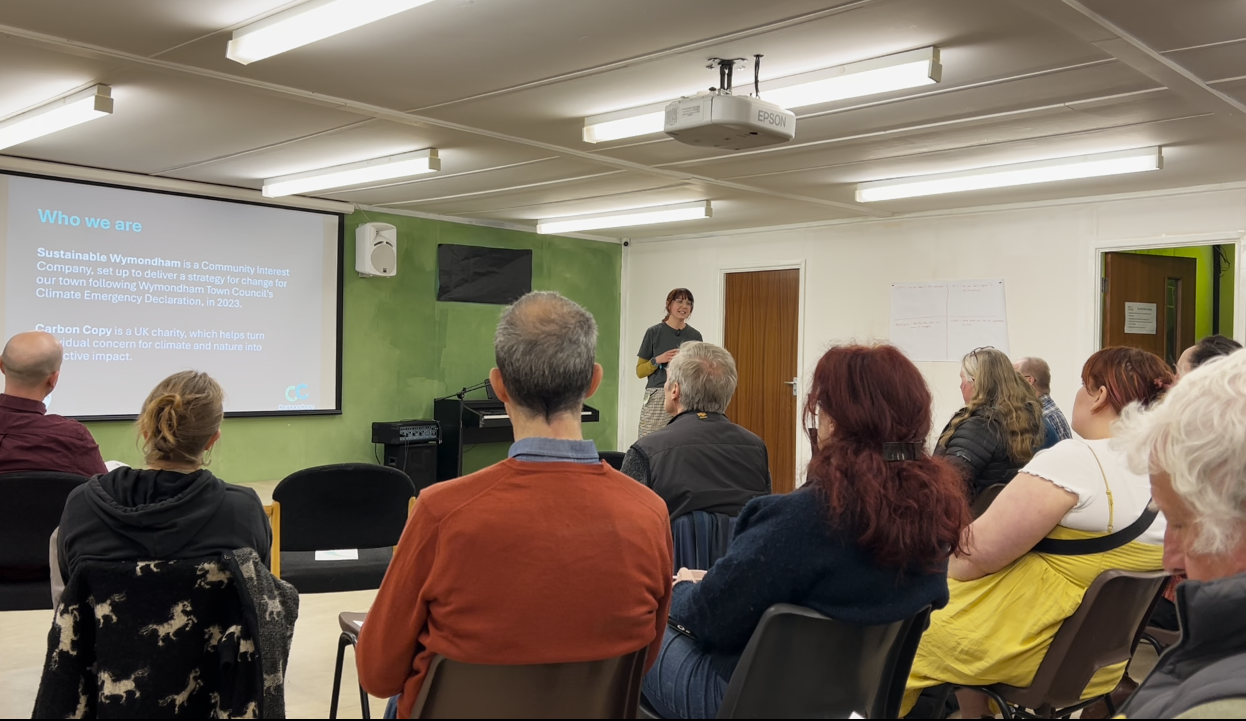
How can the People’s Emergency Briefing help to create more local - as well as national - action for climate…
-
From Footprint to Changeprint
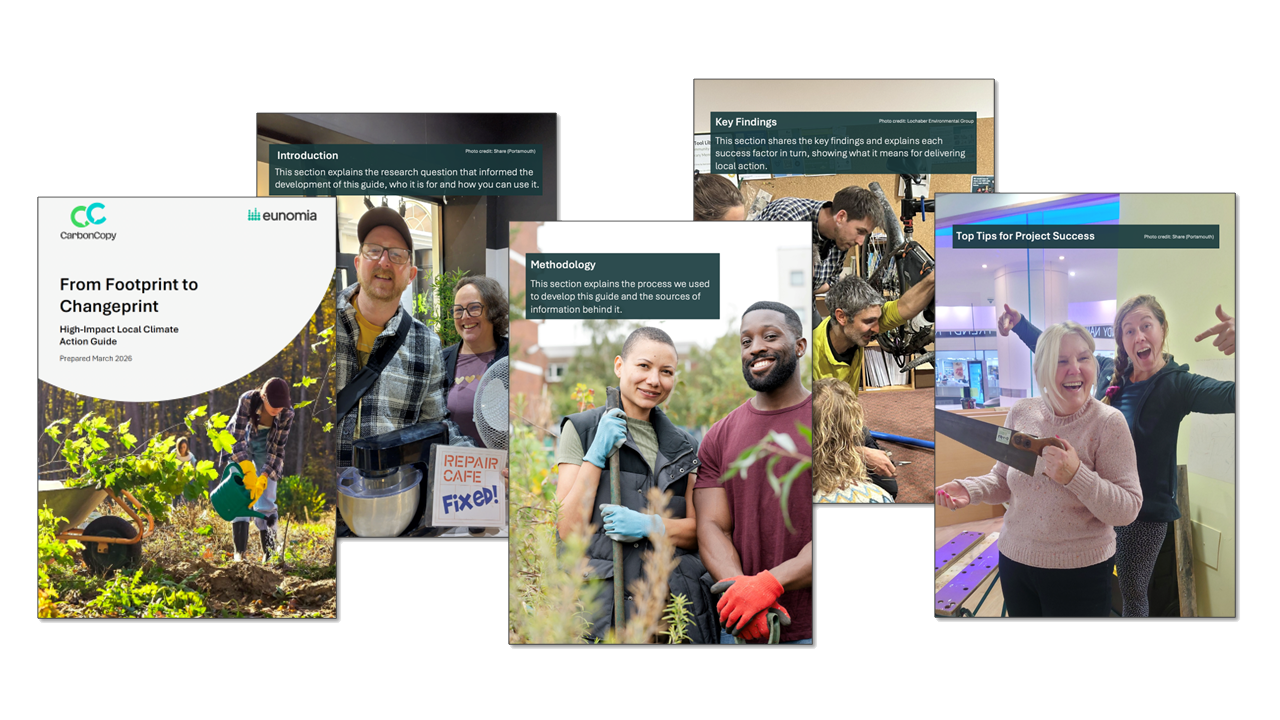
How do some local climate initiatives create such remarkable impact? Find out in this special video podcast episode.