A Local National Emergency
Connecting the dots between the reaction to the People’s Emergency Briefing, and the urgent need to act nationally, locally and collectively for climate and nature.
In April 2026, the People’s Emergency Briefing began to roll out across the UK. The 50-minute Gogglebox-style film, includes footage taken at the National Emergency Briefing event held in Westminster in November 2025, interviews with climate experts and scientists and reactions from celebrities and members of the public. The team behind the briefings: brothers Simon and Nick Oldridge and their colleagues, hoped for screenings in every constituency in the UK, and for as many MPs as possible to see the film and to show their support for a national televised briefing.
Isabelle Sparrow, host of the Carbon Copy Podcast, is also a member of one of the local organisations that signed up to put on a People’s Emergency Briefing event, Sustainable Wymondham. This episode of the podcast tells the story of her experience, and of how the groundswell of awareness and urgency around the climate crisis created by the film can be channeled into more action.
Listen or watch now to:
- Learn where the idea for the National Emergency Briefing came from.
- Discover why the film was made and why hosting screenings in communities is so important.
- Hear from attendees at the Wymondham event – why they attended and what they thought of the film.
- Hear a local MP’s perspective.
- Understand what the long-term goal is – and how you can get involved and make a difference.
Show notes
- Find out more about the National Emergency Briefing: https://www.nebriefing.org/
- Find a People’s Emergency Briefing screening near you: https://www.nebriefing.org/screening-map
- Read more about Sustainable Wymondham: https://sustainablewymondham.org.uk/
- Discover place-based projects to copy in your own local area: https://carboncopy.eco/initiatives
- Download a copy of From Footprint to Changeprint: https://carboncopy.eco/changeprint/report
- Listen to previous episodes of the Carbon Copy Podcast: https://carboncopy.eco/podcast
- Susbscribe to our YouTube channel: https://www.youtube.com/@carboncopy_eco
Podcast transcript – click to read
Nick: We know that we’ve got the tools to do the job. It’s like if your house is on fire and you have nothing in front of you to to fight it, you know, but your house is on fire, but you’ve got a massive fire hose in your hand and it’s, you know, right, I I’ve got a plan. I can I can I can tackle this.
Izzy: The first National Emergency Briefing event took place in Westminster in November 2025. The organisers, brothers Simon and Nick Oldridge, and their team planned to bring as many MPs and other leaders together as possible to hear from experts about the reality of the climate emergency.
Now, six months on from this important moment, the National Emergency Briefing is being rolled out across the UK. This is being called the People’s Emergency Briefing.
I’m Isabelle Sparrow. I’m Head of Communications at Carbon Copy and if you’re a regular listener, you’ll know also the host of the Carbon Copy Podcast. I live in a small town in Norfolk called Wymondham and when I’m not working for Carbon Copy, I also volunteer in a local environmental group called Sustainable Wymondham.
In March 2026 at Carbon Copy, we were in the throes of putting out our research on the shared characteristics of high-impact local climate action projects. At the same time, my LinkedIn had been buzzing with climate folk talking about the People’s Emergency Briefing. And so, we signed up to host a screening joint hosted by Sustainable Wymondham and Carbon Copy at a local community hall round the corner from my home.
Carbon Copy is a UK charity and our focus is on local action for climate and nature. Knowing that hundreds, perhaps thousands of organisations and groups were signing up to host People’s Emergency Briefing events in their local area, we thought there was a great opportunity to join the dots between the film and the big question of “what’s next?”
We’re getting ahead of ourselves… in the words of Julie Andrews, let’s start at the very beginning. Here’s Nick Oldridge, who co-founded the National Emergency Briefing with his brother Simon, explaining where the idea came from.
Nick: I was minded to do the line from “Withnail and I,” “We’ve come on holiday by mistake!” “We’ve become climate campaigners by mistake!” Um it yeah it sort of evolved. We both were working in the climate space, and I was asked I’ve been asked this question a lot and it wasn’t until getting the question that going back and thinking as to why, that I’ve properly worked it out but we used to be in manufacturing. We used to run a business together and back in the we used to burn gas to make clay tiles like in a kiln and so that’s lots of energy.
And back in 2000 they were talking about you might not be allowed to do this ’cause carbon you know carbon tax car limits on that and I think we we entered the conversation on climate super early.
And so Simon and I have always intersected and shared thoughts on climate scientists and who should be listened to and what reports were worth listening to and he just mentioned one day that he thought it was a real missing… something was missing in the the way we communicated it and we did it in COVID for all the negatives everyone’s probably got relating to COVID, but the bit at the beginning when experts lined up behind behind um uh what do you call them? Lecterns and and told us serious stuff but directly from the experts not through a mouthpiece you know of a politician or or a journalist. And everyone properly listened didn’t we?
And so the idea was why don’t we do that for climate? And he was he was busy getting on with it. He was going to hire a room in Portcullis House and do it to a hundred MPs and then so we were just sort of exchanging you know who might be good to bring in for that. And then one day he told me “I’m going to hire Westminster Central Hall uh and make it a little bit bigger!” And that was when when after I’d fallen off my chair I said okay we’re going to have to do this together because you can’t do that on your own. You kill yourself!
Izzy: Right, so potentially if you aren’t working in a climate sector job, you might be thinking, “Hmm, all right, you said at the beginning that over a thousand people came to this thing, but I didn’t hear anything about it?”
Well, there’s a bit of a trend for this. In June 2024, over 60,000 people marched through the streets of London asking for more political action to protect nature, but mainstream media mostly stayed completely silent.
The narrative of public concern for the environment is one that is consistently underplayed in the media and this in turn perpetuates feelings of hopelessness and isolation amongst the silent majority.
Here’s Nick again talking about the coverage of the event in November.
Nick: As an organisation that was built from scratch, not known to the press. Um, I suppose you would argue that we did really well because we got on ITV, we got on Channel 5, we got on uh we got on quite a few got on quite a few… Our media our media coverage was good. Um, but then we were extremely worried exactly as you say and we talked about the event you mentioned about being completely ignored.
Um, and this is one of the reasons we leaned in so hard to the creative angle of it, the way it looked and felt. And we also put quite a lot of resource into PR getting some celebs there which you know how however you look at it makes a difference for people turning up and people reporting on it.
And so we did puncture through but it wasn’t exactly featured on the BBC.
So we didn’t reach the MPs that we really need to reach especially the ones that you know ministerial level the ones that are on select committees or the ones that are making these big decisions now that are probably not aware of the risks or the time scales and probably spend too much time listening to lobbyists and vested interests.
So that was a disappointment, but in a way we always knew this second part was coming. Yeah. So we can come to that. But we always knew that um we we would leave this calling card, make this big, you know, splash and then we come back to phase two, which is about going via constituencies to get it to the MPs.
Izzy: Progress was underway with the Wymondham screening event. We wanted to get in there early to host our event as close to the launch on April the 7th as possible. So we’d given ourselves a rather ambitious three-week planning and promotion window!
Luckily, my fellow Sustainable Wymondham group members and I were on it sending emails and setting up a registration page.
So, you emailed uh you emailed our MP uh you emailed his office. Uh have you heard back from them at all?
Paul: Yes, his assistant Cathy um said he did have another appointment, but she wasn’t sure if it was going ahead. So, um she said she’d get back to me and yeah, thankfully she did and he is now available. So, he’s yeah, he’s booked now for the 23rd.
Izzy: That’s great. And do we know if he’s there kind of in his official capacity? Like, do you think he’ll be available for people to chat to him about about…
Paul: I believe so, but I’ll I’ll send an email to double check, but it was I sent the um the official letter, you know, the template, yeah, with my constituent um address to show that I was part of the constituency etc. So it is quite a you know formal request. Yeah. But I will clarify.
Izzy: Yeah. Because I saw on um the on the map um the National Emergency Briefing map um the only other screening that I can see at the moment in South Norfolk is in Poringland, but it’s not until next month. So hopefully we’ve we’ve kind of got the first one that he’s going to be at. So that’s that’s good.
Paul: Yeah.
Izzy: Those who had registered to host a screening were invited to a special online viewing of the film with an opportunity for a Q&A afterwards with the team. This was a really valuable opportunity for me to understand more clearly the intention of the film and to give me more clarity when inviting people along to our screening in Wymondham. I wanted to know from Nick who, in his mind, was the most important audience for the screening event.
I guess that brings us quite nicely onto the intended audience for these community screenings because um having seen the film, I saw it yesterday. Um I felt like it was really really incredibly well made in terms of being really accessible, really um you know I was worried beforehand to be frank. I was worried it was going to be quite dry and quite um um fact heavy. Um but the way that it’s structured is is really yeah um um pacey and and engaging and there’s a really good balance between um uh you know members of the public, celebrities, experts so that you don’t feel like you’re just listening to a whole load of data. Um, with that in mind, who is your, I mean, obviously we want MPs at all these events. That would be great. Uh, because they’re the people that you’re kind of asking for support with with the with the big ask. Um, but in terms of community members, who who is this for? You know, looking at the poster for example, looking at the kind of um website, it all looks quite serious and and it is, obviously, it’s an emergency! Um but it it it doesn’t necessarily say, “Oh, that’s going to be a jolly nice night out.” So like what is the what is the thing that we can we can say to people to say actually, even if this isn’t something that you think about on a daily basis, you should still come to this.
Nick: So I think the target audience, which we might not have said this at the beginning is the people in the bubble first and foremost to properly equip them with knowledge that they can use to help communicate this out.
So I think what’s going to happen, I think the like the early adopters like you who very amazingly kindly putting on these screenings are that’s the that’s us planting seeds and getting the whole thing moving. What we’re hearing in the feedback is people are all instantly agreeing well let’s do another screening and so I think we will quite rapidly see it bed in with people who are already in the know, but like I said will now be just a little bit more focused and know all the latest science and be a bit more confident about what they know and then hopefully that disseminates outward as those people start to invite people, and then we start to see these screenings that are more specific to different sectors.
So, I think that’s how we’re going to crack this. But it is it is an undeniable challenge. I mean, the reason why I did climate comedy is because who wants to listen to a climate scientist? So, we we wrapped it up in jokes and slipped it in that way. So, yeah, it’s it’s a really hard one to to make work.
Izzy: We know that over 70% of the UK population as a whole are concerned about the climate crisis. But just because the majority are concerned doesn’t mean they’ll be moved to come to something like this. I sent the invitation to lots of local businesses, organisations, and community groups, many of which were not at all environmentally focused, but in reality, I only got response from a tiny handful.
Um in terms of what I’ve been doing. So, I um sent a bunch of, I shared I made an event on the Facebook page and uh because people tend to like Facebook likes it better if you make an event on their own pages. So, um yeah, I made an event on the Facebook page and uh I shared it to like a lot of local groups just now. Um, so I think I’ve shared it to like like 20 groups?
It’s no good if people inside the “eco-bubble” are talking to themselves. So reaching a broader audience is really important, either at a screening event itself or afterwards as attendees are fired up and are looking to get others more involved. There’ll be more than one reaction to what people see at the screening. Some people will want to reflect. Some will want to learn more. Others will want to lobby their MP and push for a national televised briefing and others will be ready to act locally and join in in making bigger changes happen. Collective local action is where I think Carbon Copy can help a lot, as this is something we’ve been showcasing and supporting for several years. And this passing of the baton as it were to organisations more equipped to support people following the screenings was exactly what Nick told me was the plan.
Nick: In a in a very handholdy way are are taking people through and into the arms of people like Zero Hour, The Antidote, Parents for the Future. There’s a whole… The Climate Majority Project. There’s a whole lot of groups…
Izzy: Carbon Copy!?
Nick: Carbon Copy, Carbon Copy!
You got groups like you who all have a different take and and the reason that’s so important and you get this debate and you probably see it on LinkedIn and climate circles about how you should and shouldn’t do and say things and what the rules are and, but we’re all different and we’re all we’re all at a different stage.
We’re all coming from a different place. We’ve got different cultural um takes on this. So, I think having a whole bunch of uh very open doors to push against where you’re received in a way that recognises that you’ve just seen the film and now you want to take some other steps is really important.
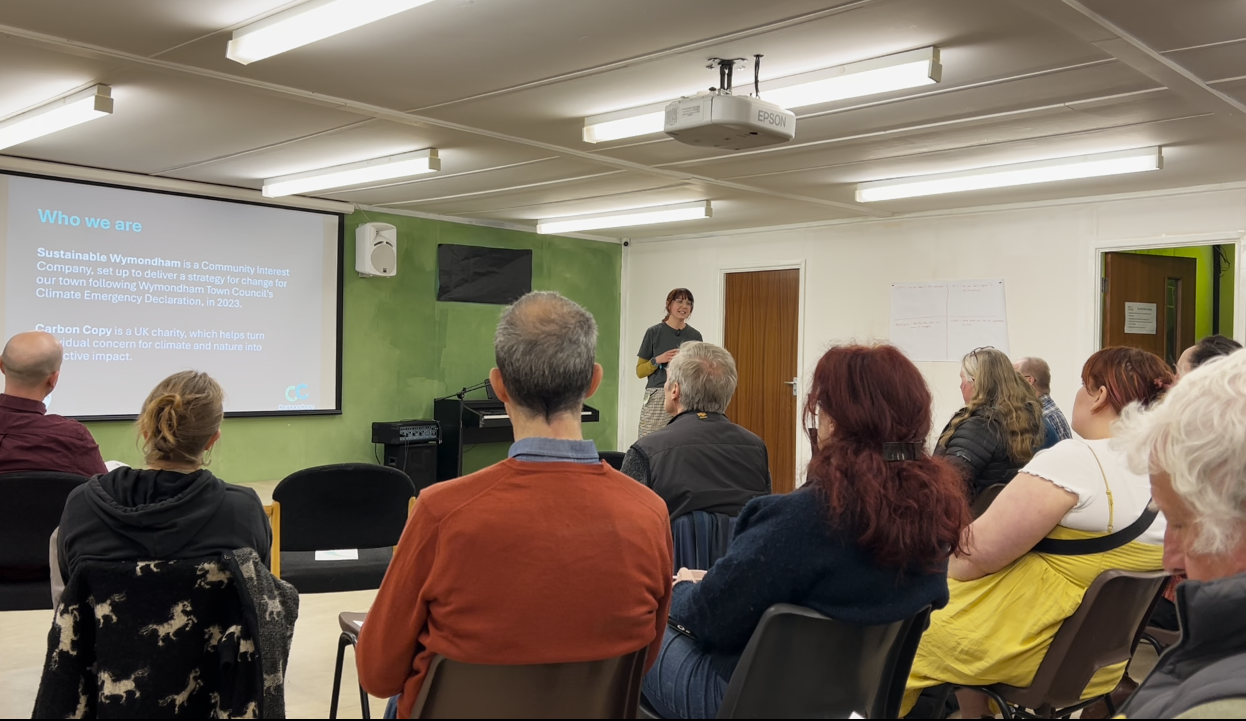
Izzy: So, we are here at Rothbury Community Hall. It’s about 3 minutes past 7 and um the hall’s filling up and I’m really pleased because uh we had 29 people registering and we’ve already got 26 people who have arrived um and quite a lot of people who weren’t even on the list. So that’s good. It’s going well. Um and our MP, uh Ben Goldsborough is here. Um so hopefully going to catch a chat with him after the film. And um yeah, we’re going to kick off in about 5-10 minutes.
Hello. I’m Izzy. Um I’m a member of Sustainable Wymondham and I’m also um here on the behalf of Carbon Copy. This is a t-shirt with an old logo that’s out of date, but you know, sustainable not getting a new t-shirt!
[Laughter]
Just a heads up that if you’re enjoying this episode of the Carbon Copy Podcast that we’d absolutely love for you to leave a review or a rating. It really helps other people find the pod and there are dozens more episodes to check out. Just head to carboncopy.eco to YouTube or wherever you usually listen.
Immediately after the film finished, I asked people in the audience if before the break they could let us know their instant reactions. We left out some paper for people to write their feelings on and also gave people an opportunity to place stickers on a chart with four options for what next: reflect, learn, lobby, and act – just like I mentioned before.
During the break, I took the opportunity to catch up with a couple of attendees to hear their thoughts and reactions. Here’s Matt.
Matt: Um, yeah, I’d say sort of overwhelmed. I think I think throughout most of the film, I was like overwhelmed with a feeling of this is a lot of information. And there’s also a lot of very sort of negative information about what we’re dealing with right now and what we have been doing and what we’re set to continue to do if there’s no change. Um and then at the very end there’s sort of like a few points that are just like, no this is what we can do, this can be done, this can be done; and that sort of gave me a bit more pep I guess!
Izzy: Despite, as Matt says the hopeful moments towards the end, this feeling of overwhelm was something that Nick and his team anticipated when planning the campaign.
Why is the tactic just in-person screenings? Why are you not offering this out um as an online event um option?
Nick: We we eventually will. So that will will eventually happen and who knows if if a network picks it up, that would be even better. But uh as you said at the very beginning, this is heavy. Uh the information lands can can land quite hard. When we were working on all the guidance documents that we have put out that you will have seen from the the thing you attended. So the screening guide and the facilitation guide we work with the Climate Psychology Alliance. So we really try to take on board some of the issues that we’re going to be evoking from talking about this stuff.
And from that the logic just stems that you really don’t want people watching that on their own. It’s it’s just not something you want to we consume so much media on our own, don’t we? In isolation and and I think that’s one of the reasons apart from the content itself why social media is having such an impact on us because we’re doing it on our own.
So there’s so much data on how people receive information in groups. So that and it’s much more positive. So that’s one thing. The other thing is you can’t find agency on on your own. Um you know you watch it and you think all right what can I do? It’s all going to be internalised by you.
So being in a room facing it together and then realising in that room are people that are already part of some of these groups and can introduce you to all the things you could be doing. So it’s a it’s a networking next steps agency driven moment to be in a room together with people to receive this. So to us it just a no-brainer.
Abie: My name’s Abie Raynsford and I’m here partly because I’m deeply concerned about the environment. I’m a gardener. I have I live on the land. I I’m deeply upset about the farming, the agricultural systems. When I was a child, I used to I used to go out looking for frogs, but now all the ponds around the areas near the farming in the fields. There aren’t any there aren’t any amphibians anymore. I want more hedgerows. I want us to sort the water out. I mean, I’m here because I care and I want systemic change.
Izzy: So, how do we get there? On our “What next?” chart, the two most popular options at the Wymondham event were “lobby” and “act”. I’ll come on to act in a minute, but what if we focus for now on lobby. What should people do? What is it that the National Emergency Briefing organisers would actually like to see come of this event?
I if if you do achieve the thing that you want to achieve, which is to get this national televised emergency briefing um uh on on major TV channels, it may or may not it may or may not happen, but but what would be what would be sort of the outcome that you would hope and expect following that following that goal being achieved?
Nick: Let’s take the hope angle first. Can you imagine uh you so you know with tipping points you never know how close you are to the tipping point until you get there and then bang it happens. So I suppose in the super hopeful version of this is is the film triggers a tipping point and then me and Simon don’t have to you know work this hard day in day in day out trying to make this happen. Um and it all just follows from there which but I think that’s doubtful. I I am what we’re trying to do is just focus on the roll out. We’ve got plenty of ideas for what happens next.
Um, you know, you could have a – it’s not as if the other side are going to go, “Oh, all our disinformation has been pushed aside by this National Emergency Briefing campaign. Let’s just give up.” That won’t happen. Um, they’re going to double down and keep pushing out even even who knows what will come next.
So, there is a strong argument that we will have to do a recaps, updates. But we just have to keep the information on the table and keep the public plugged into these experts ’cause we really do think that was the missing link in in lots of this that people read this stuff in a in a in a like I say a hyperbolically screaming headline that was all doom-laden. They didn’t listen to it the detail of it and they didn’t listen to the experts. So keeping those experts plugged in is really important.
How that shapes out I really don’t know. I think what’s probably going to happen is is the international stuff will pick up and as the international stuff picks up maybe that will then bring attention back to the UK and and what our next steps are. But but right now we’re just scurrying along trying to make screenings happen as in in the highest numbers as we can.
If nothing comes out of this but the fact that we’ve nudged many many many more people into joining anything. It could be to do with food. It could be do with transport. It could be do biodiversity and those numbers are sizable enough then then we’re going to create a ripple. But also again I keep bringing it back to the MP. If you join a group you’re just making it more obvious that there’s more people who are trying to take action and care more. And I think we have to keep reminding ourselves we’ve got to evidence this level of public support so that people in government and I I wouldn’t want to be an MP for any for anything. You know, can you imagine? So, so you can get cross with them because they’re not doing what you want, but that doesn’t get you anywhere. What we have to do is make it so powerfully evident that the public are wanting this and they’re wanting them to take bolder action that they feel that that it’s safe enough for them to go and push it.
Izzy: This seemed like solid logic to me, although in speaking to my local MP, Ben Goldsborough of Labour, things didn’t seem quite so simple.
What do you think other MPs are going to be doing with this information? Because the idea of this whole campaign is to get as many people like you along to events like this um and to kind of motivate them to do more um in parliament. Um do you think that’s going to be effective? Do do you think a national televised broadcast is something that’s on the horizon?
Ben: I don’t think a national broadcast is on the horizon. And I’ll tell you for why, because I think that’s the easy option out. I think any government that went for that don’t take the issue seriously, because what they want to do then is as you sort of alluded to when you spoke but in a different way is you can say that’s a big bang. Let’s do a big process and a big sort of TV show and then we can say we’ve done what we need to do. I prefer a government that put its efforts into actually taking action against climate change and nature depletion and that’s a harder option because people don’t see it immediately. I must admit as a constituency MP right now my inbox is not telling me that I need to take action on climate change.
It’s telling me that actually I need to oppose renewable energy in my constituency. It’s telling me that I need to oppose battery energy storage technology. I need to oppose not drilling for more oil in the North Sea. And these things are where a lot of the population still are. But people don’t trust politicians. Because they’ve been let down for too much whereas I do trust people like yourself Izzy who will go out there and be able to tell a human story and that’s where we need to get as a country right now.
Izzy: How do you kind of weigh that against you know all the evidence that suggests that that 70 to 80% of people are really concerned about climate change and want more action. How does that figure if you’re saying that there are people who are actively asking you not to support it?
Ben: Because it’s the next question. The next question after that is not you want more action. Fine, we all want more action. You you say to someone you want to be healthier, you want to live a happier life and you say, well, what action actually is needed? That’s when people peel away. So when you turn around to people in like in in the film that was shown there, it said we need to ideally cut down our meat intake. When that’s polled, that’s not a popular thing. When you poll people of, would you be happy for a large solar farm to be in your back garden? Again, the polling goes right the way down. The easy question is, should we act? The hard question is how we act. And that’s where, as a society, we’re not at right now because people are not seeing or interacting directly all the time with the impact of climate change, with the impact of food security issues.
Izzy: Um, I don’t know how I feel about this. I came away from this chat feeling honestly a bit frustrated. I think actually based on all of the stories I’ve heard over the last five or six years at Carbon Copy through speaking to literally hundreds of change makers across the UK, people do want action and taking action really does make stuff better. Yes, there are a vocal minority who oppose things, and unfortunately, it’s almost never those who think something is a good idea who email their MP about it, but I’ve never spoken to anyone who’s regretted their local initiative! I’ve spoken to many people who’ve been completely delighted and overjoyed by just how much of a positive change their project has brought.
We talk about growing a Changeprint rather than shrinking a carbon footprint, which in basic terms means focusing on doing more good, rather than on reducing harm. We know that for some climate is an instant turnoff, net zero is meaningless, and sustainability is just jargon. We also know that as is pointed out in the film, people have a lot to think about and sometimes the link between taking action on climate and reducing bills, improving food security, and making our communities safer isn’t made that clear.
Those wider benefits, the positive impacts that should make taking climate action a no-brainer are being felt by people up and down the country who are already creating a Changeprint locally. Our goal as a charity is to shine a light on this good stuff and to encourage more people to copy it and adapt it where they are.
Many of those attending the Wymondham event said the film made them want to act. That’s the response they put on our wall chart. And the good news is there’s lots of support out there.
Almost every area across the country has a local climate and nature plan in place for people to rally around. There are community groups of all shapes and sizes as well as workplace schemes. Schools are also doing some good stuff leading local environmental projects outside the classroom.
As Nick mentions, we have a wonderful opportunity to do something bigger together locally. For those who feel ready to take the next step, one of the free resources now available is Carbon Copy’s high-impact local action guide: “From Footprint to Changeprint”. It contains useful evidence-based information about the shared success factors and characteristics of local projects and how you can integrate these into your own work.
I’ll stick a link in the show notes to this and to other useful bits and pieces to help you act now.
How hopeful do you feel? Like what how hopeful do you feel that we can get through this and survive this and that the future is going to be, you know, better than some of those quite terrifying predictions that are in the film, you know, like what what gives you hope and do you have hope and how do you hold on to that?
Nick: That’s a really good one. Um, I try and be succinct. Uh, I I think the natural thing when you when you Mike Berners-Lee talks about going through a one-way gate, when you properly let it all land and digest this information, not the, “Oh, I think something’s going to happen in the future to do with ice caps.” You know, the the real deal. You take it on board. Obviously, the trajectory is you you go down before you come back up, but you always come back up, I think, if you get involved in things.
I think if you’re going to end up in a place of feeling just I’m just at a loss, maybe the answer there is to go and connect with other people who are doing things. So for me it was going right, no one’s listening to these climate scientists. Even when I send them to my friends, they’re not really properly absorbing this. So I found my hope and my passion and my energy from making those climate comedy films.
And it’s the same with this. And we are in this incredibly fortunate position ahead of a horrible thing that might happen. Do you can you imagine for a moment if this horrible thing that might happen was coming down the tracks and we didn’t know what to do. I mean that’s proper doomer stuff, isn’t it? You might as well have red wine for breakfast at that point! Um or build a bunker. I don’t know.
But I think Tessa Khan’s really good at this. This is a solvable solvable problem. You know, it’s all the timing might be the scary thing. And that’s probably what scares me most. Will we solve it quickly enough? I think we’re going to win in the end. It’s just whether it’s just the time scale in which we do the thing that we know we’ve got to do. So, I’m really enthused by that.
You know, you can take any of the talks that were at the briefing and they’ve all got a kind of positive story behind them. I think the lady with the red hair, the member of the public who was on the sofa in the film said said a great line. I’m going to have to learn it actually. It’s something along the lines of we don’t we don’t have to work all this out. Like, it’s there. They already know it. We just need to go and do it. So that yeah, that’s what gets me out of bed every morning. We know that we’ve got the tools to do the job. It’s like if your house is on fire and you have nothing in front of you to to fight it, you know, but your house is on fire, but you’ve got a massive fire hose in your hand and it’s, you know, right, I’ve got a plan. I can I can I can tackle this.
Izzy: So that’s it for now. Like many of the groups we’ve brought on screening, Sustainable Wymondham is looking at holding a follow-up event to continue the discussion and bring more people together. There are more and more events being added to the map on the National Emergency Briefing website all the time and more people sharing their thoughts and their reactions to the film. For my part, I hope that there will be a wave of people in response who are ready to act locally. We need action at all levels. We would like individuals everywhere to see this film and feel the urge to do something more. We want more urgent and ambitious leadership nationally by politicians who see the better, brighter future if we live more sustainably. And crucially, we need people to come together locally, channel the human energy that exists all around us, and take collective action.
This episode of the Carbon Copy Podcast was written, produced, edited, and hosted by me, Isabelle Sparrow. Additional footage was shot by Renee Karunungan. You can find all of our previous episodes via the Carbon Copy website or wherever you get your podcasts. If you’ve enjoyed this, please leave us a review and subscribe to hear our future episodes as soon as they land.
Enormous thanks to Nick Oldridge, co-founder of the National Emergency Briefing. To Paul Barrett, Rob and Julie Morgan, and Andrew Robinson of Sustainable Wymondham, to Abie and Matt, the attendees who I spoke to, and to Labour MP Ben Goldsborough for chatting to me. Until next time, goodbye!
Recommended from Carbon Copy
-
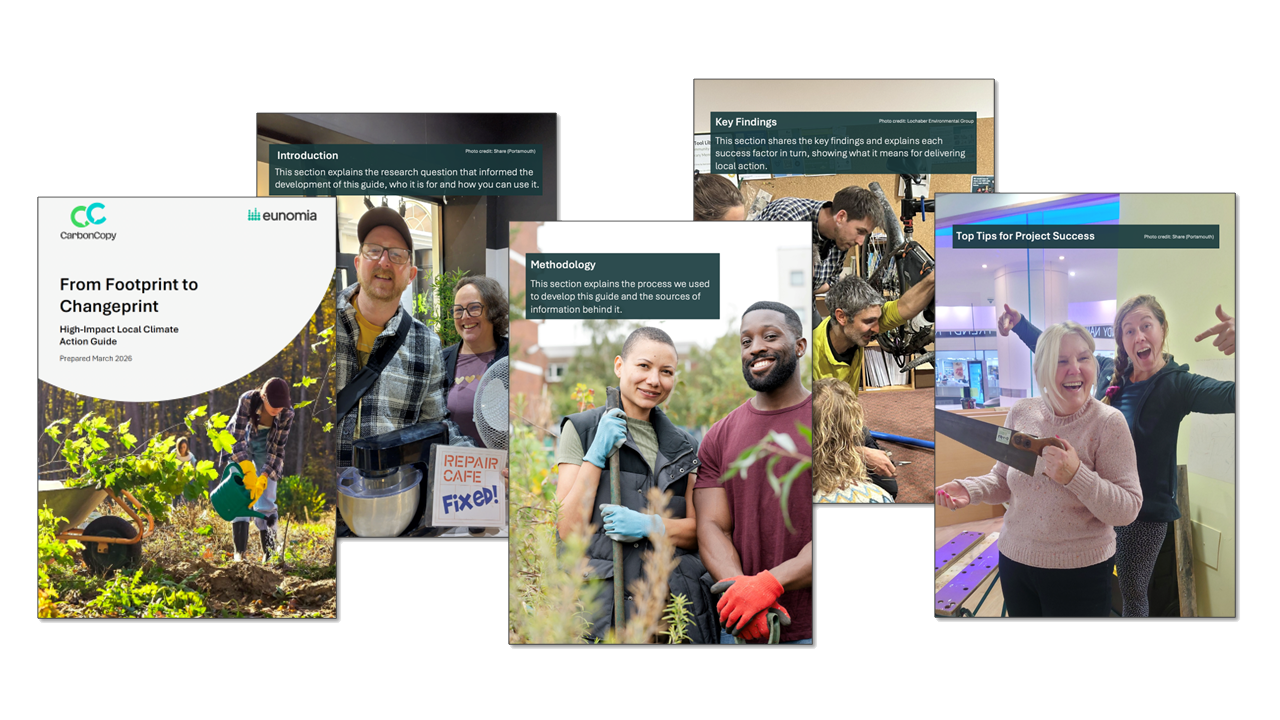
From Footprint to Changeprint
How do some local climate initiatives create such remarkable impact? Find out in this special video podcast episode.
-
Introducing Changeprint
Every action leaves a Changeprint. Discover a new narrative about doing more good, instead of less harm.