Take a leaf out of this book: just say yes!
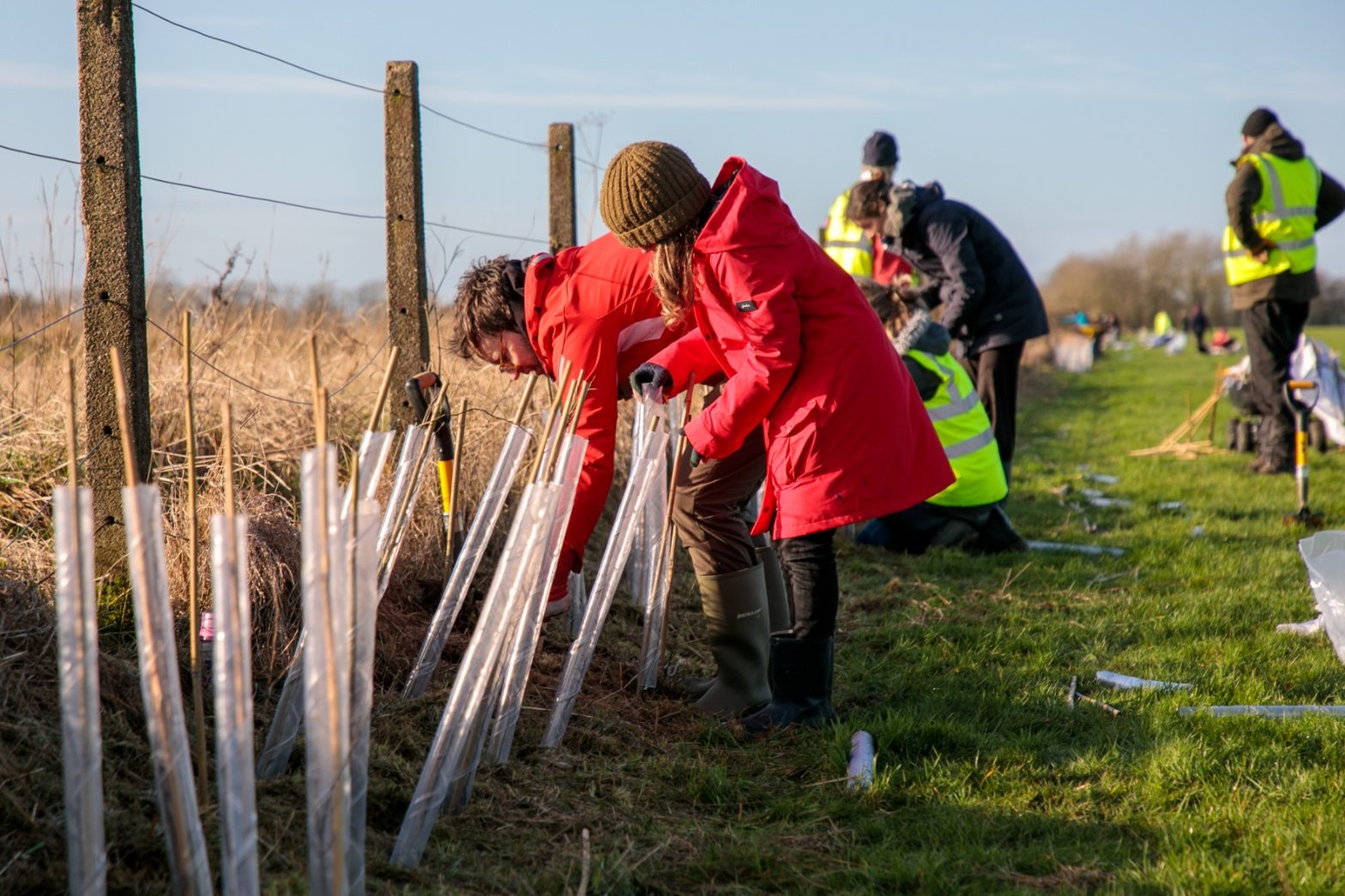
How a community group focused on nature-based solutions helped everyone, from kids to corporates, to find the joy of getting your hands dirty and making a real difference.
Like many people, Bruce Durham, co-founder of Harborough Woodland, began his journey into climate action in response to the impact on children. In Carbon Copy’s fourth and final Community-to-Community Workshop, focused on nature-based solutions, Bruce told host Roy Kareem how a primary school climate protest outside his district council offices changed everything; and how that turned into one of the most prolific grassroots tree-planting and flood-prevention operations in the country.
It’s a story about trees, rivers, land and people, and the surprising power of simply asking for help. Here’s what Bruce shared, in his own words.
What is Harborough Woodland?
Hearing his own grandchildren chant “Whose future? Our future!” outside the council offices sent Bruce digging into the numbers. What he found was stark: South Leicestershire has the lowest woodland cover anywhere in the UK bar Cambridgeshire, at just 3-4%, compared with 25% in Surrey. Biodiversity locally was the lowest in the Midlands, and the area flooded regularly.
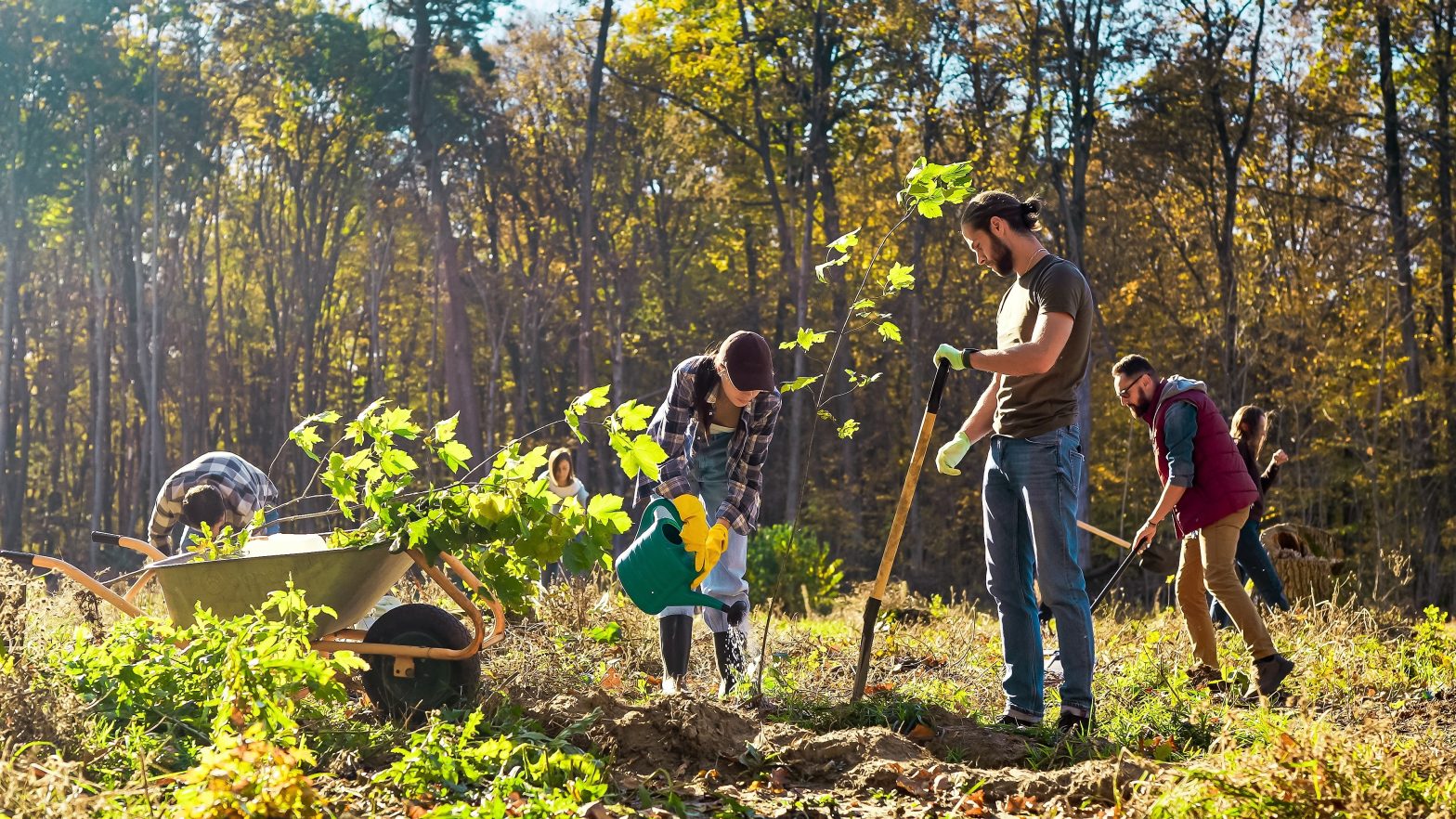
Trees, Bruce realised, were the easiest possible way to start fixing this. “Trees are nonpolitical,” he said, “it’s an easy door to open. Most people love trees. We can get free trees. We can get free volunteers.” Harborough Woodland was founded in 2020 on that simple insight. Since then, the group has planted 55,000 trees across three counties — almost all of it for free.
Landowners are king
The project started with primary schools, because Bruce and his team already knew the teachers — and some of those teachers’ parents had farms. From there, roughly 30 community presentations about the benefits of nature-based solutions opened further doors. But the real lesson was simpler: “Nothing happens without landowners’ permission,” so getting in front of the right landowner is everything.
Many of the farmers Bruce approached had been, in his words, “abused by governments for decades” and were understandably wary. The approach that worked was treating the landowners like customers, doing the work properly and at no cost: fully insured, with proper risk assessments, using trees sourced free from The Woodland Trust, TCV, Leicestershire County Council and Highways England. That professionalism built trust — and trust led to introductions. “That then allows us to do more”, Bruce explained, because farmers “introduce us to their friends.” With no money, no bidding and no invoices to chase, projects can move fast: some landowners have handed the group five years of ongoing work.
From trees to taming floods
As Harborough Woodland kept planting, a contact at Leicestershire County Council pointed out that natural flood management (NFM) — using trees, ponds and reshaped waterways to slow and absorb floodwater — was an obvious next step. Inspired by a national Facebook group called Tree Planting Group UK, with over 20,000 members swapping advice, Bruce set up an equivalent: Natural Flood Management UK, which now includes universities and specialists answering questions from groups across the country.
The group’s first major NFM project began with an email forwarded by Harborough District Council from a frustrated landowner asking: “What the hell can I do with this field?” whilst literally standing on an island in a flooded field near the village of Smeeton Westerby. The team suggested talking to The Rivers Trust, and the conversation snowballed into the first large-scale natural flood management project in the Upper Welland catchment. Actions included “rewiggling” a brook that had been artificially straightened in the 1800s, creating new ponds, and lengthening the watercourse to reduce flooding and boost biodiversity.
It took two years, partly because record February rainfall left excavators stuck in the mud. That project has since led to a second, six to eight times larger, now under construction with the East Mercia Rivers Trust managing the project, the Environment Agency overseeing impact, and funding from Anglian Water and Section 106 developer contributions via the district council.
Nature’s sponges: the science bit
Why do trees and hedges reduce flooding so effectively? Bruce explained the mechanism: tree roots partner with mycorrhizal fungi, which build a sponge-like structure in the soil beneath them, pushing organic material down through even dense clay and creating channels that absorb and hold water. By one estimate — which Bruce suspects is conservative — a single metre of mature hedge can hold 3 to 5 cubic metres of water in its soil. A mature oak holds vastly more.
This isn’t a fringe idea. The same sponge-city principle, using trees, hedges, rain gardens and planters to soak up water before it floods streets and homes, was pioneered in China and is now used successfully in different UK towns and cities from Slough to Mansfield to Swansea.
Finding the right people
Before starting their own natural flood management work, Bruce’s team sought advice from Slow the Flow in Calderdale and Pickering, groups with several years of experience already. Their advice surprised him: forget raising money first. “Get your Facebook out,” they said — build the network, and the volunteers, opportunities and funding will follow.
Sometimes the approach is even more direct. After reading an article by Anglian Water’s environment director Robin Price about similar work in Norfolk, Bruce simply wrote and asked him to do the same in Market Harborough. He responded, and has been an enthusiastic supporter ever since. Part of what makes water companies easier to work with, in Bruce’s view, is that they understand the perspective of addressing customer needs. Anglian Water, for instance, has every incentive to help: much of the sewage flooding reduction that it’s funded and customers demand is itself caused by flooding, so solving one problem helps solve the other.
Why volunteers keep coming back
After six years, Bruce’s core team of 16 ran a secret ballot asking why people keep turning up every winter weekend to get cold and muddy. The honest answer, by a clear margin, was wellbeing — the fun of it, and the people. Education came second; nature and the environment, which Bruce expected to top the list, came third. It’s a finding backed by plenty of published research on the mental and physical health benefits of time outdoors and joining in.
That spirit shows up everywhere in the group’s 800-strong Facebook volunteer base. At one family planting day, volunteers put in 6,000 tree whips across 1.2 kilometres in just three mornings, with toddlers tagging along behind their parents. And when Bruce’s team planted 1,500 trees for free at a secondary school on a freezing, pouring-wet January day, the students refused to stop at lunchtime. The headteacher came out to see the progress and told Bruce: “If I could bottle this magic and take it into History and Science and everything else, that would be fantastic.”
Lessons learned the hard way
Not every planting succeeds, and Bruce was candid about the failures. Large, pre-grown “lollipop” trees look impressive but die without regular watering — a complete waste of time, in his words, unless someone can commit to that. Small bare-root whips, planted while dormant, establish far better without irrigation. The trouble is that climate change is shrinking the safe planting window: autumn leaf-drop is coming later and spring budburst earlier, squeezing the period when a whip can go into bare soil without its roots or leaves at the wrong stage.
One cautionary tale stuck with him: a tree-planting event for a dementia centre, organised for April by a well-meaning industrial landowner who promised to water the trees afterwards — and didn’t. None survived. Typical losses from whips run around 5%, but Bruce expects 20 to 30% losses from last winter’s plantings because of drought. To track this, a volunteer with a quality control engineer background set up a proper auditing process, so the team can learn from losses and replace trees that don’t make it.
Get involved
Harborough Woodland now gets more requests than it can handle, and has had to turn down work in Northamptonshire, Rutland and beyond — though Bruce is careful to frame that as “not yet,” never “no.” Where possible, the group has helped set-up sister groups in Great Glen, Welford and Broughton Astley, spreading the model rather than trying to do everything itself. A group in Rutland has, so far, proved elusive — Bruce’s appeal to anyone based there is still open!
There’s so much to learn from this excellent session about how the mindset of ‘abundance’ (identified in this High-Impact Action Guide as critical) works in practice. Watch From Roots to Riverbanks below, and keep your eyes and ears out for our upcoming podcast series, in which we will do a deeper dive into all four of our featured high-impact initiatives.
Recommended from Carbon Copy
-

Out with the oil, in with the new.
A warming look back at our Community-to-Community Workshop with Swaffham Prior Heat Network What does it take for a rural…
-
Finding the plot
How did Hull become the first place in the UK with a legal Right to Grow? What does it actually…
-
Refuse, reduce, repair, repurpose, recycle – recap!
Circling back to our Community-to-Community Workshop with Circular Malton & Norton How long does it take to move people to…
-
From Footprint to Changeprint is making an impact
How do some local climate initiatives achieve remarkable impact? We think we have some of the answers. When Carbon Copy…